A Month or So, Minneapolis

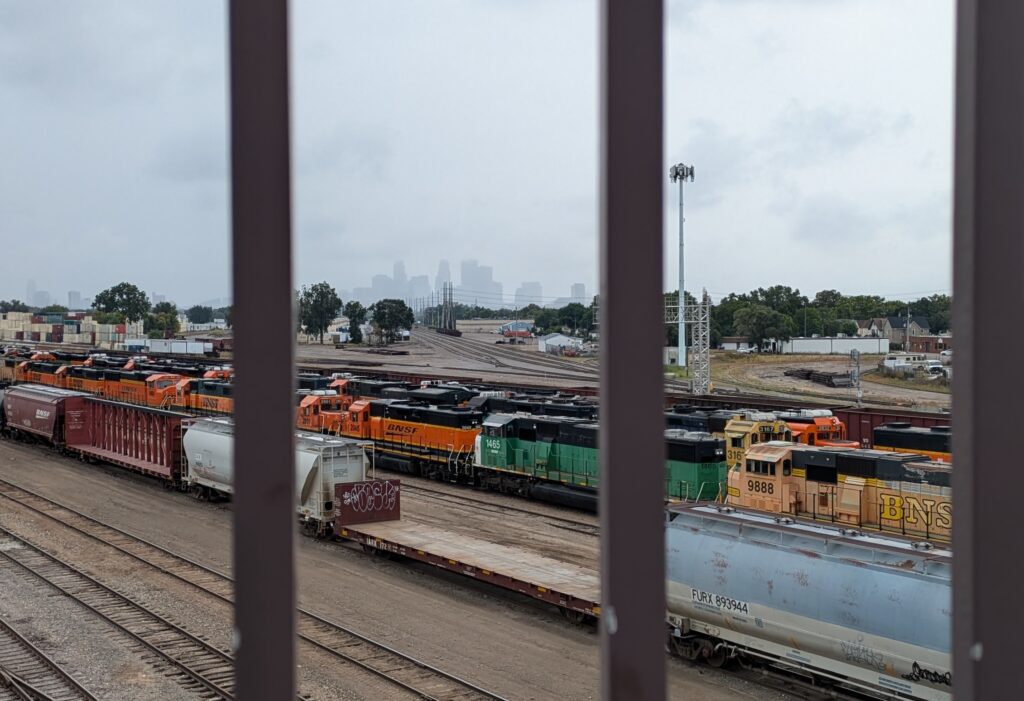
Courtesy of Jake Lancaster.
When Alex Pretti was shot ten times in South Minneapolis on a cold but sunny Saturday morning in front of a doughnut shop, I was likely three or four miles away, speeding down I-94 to make it to the airport before my wife’s flight to Florida. She was surprising her sister, who was turning fifty. It was well below zero and we were all very cranky, and running late. My son and daughter were in the back seat. We passed the Basilica of Saint Mary on the left, the Walker Art Center on the right. From the freeway you can see Claes Oldenburg’s iconic Spoonbridge and Cherry sculpture. I told the kids to look, but the novelty had worn off over the years: it was just a big cherry in a spoon, decorative and somewhat obscene. We passed under a pedestrian bridge designed by an architect who commissioned John Ashbery to write a poem for it. The poem is called “untitled bridge poem” and is stenciled across the structure’s steel girders and ends with the line (in what I’ve always thought to be a satisfying anti-epiphany) “And then it got very cool.” There’s a tunnel after the bridge, and everyone holds their breath until we make it through.
I know my way around Minneapolis. I’ve lived here for two decades, in North Minneapolis, in Uptown, Downtown, Northeast, and South Minneapolis, and now in a near north suburb, but I still use Google Maps because there’s more than one way to the airport and there’s always road construction and unforeseen traffic and, for the past couple of weeks, the possibility of a protest or march or ICE activity blocking a major thoroughfare. Machine learning can predict these things. Most human citizens who aren’t on Signal chats or ICE watch group text threads cannot.
The Hiawatha Avenue route is a relative shortcut if it’s not jammed up. It wasn’t exactly flowing. I turned down the volume on the radio, which had been playing Sabrina Carpenter.
We bought our first house east of here, four blocks before the Mississippi River bisects historically Protestant Minneapolis and historically Catholic Saint Paul. I’ve always thought of the cities this way. Purgatory to the east, no purgatory to the west.
The Maps route I started to question. We dipped through the VA hospital grounds and ended up following the light-rail on a service road. A brown Suburban full of sheriffs appeared to be on the lookout at a railroad crossing. It felt filmic, neowestern, Sam Peckinpah somewhere in the snowfields trying to figure out how to shoot in Netflix-approved 4K with a Sony FX3. A man in a camouflage hunting jacket, perched behind an electrical box covered in silver graffiti, filmed the sheriffs with his phone. Where are we? my wife said. Yeah, Dad, where are we, my son asked. Yeah, Dad. It appeared we’d wound up behind the Whipple Federal Building. Shit, I said. Sorry. I have no idea how we ended up here.
There wasn’t much in the way of passion or violence. There were a lot of people standing around, trying to stay warm in their canvas overalls and Sorel boots and fur-trimmed parkas. There was a card table with Dunkin’ coffees and Dunkin’ boxes. The Whipple building is a drab imposition of an edifice, architecturally similar to the courthouse Josef K. is remanded to in Orson Welles’s film adaptation of Franz Kafka’s The Trial. Not far away are well-maintained softball fields. The news of another person killed at the hands of ICE had not yet reached the internet.
On a sign that said EMPLOYEE PARKING ONLY, someone had markered a line through the word EMPLOYEE and written PIG above it in thick pink Sharpie, in a penmanship I can describe only as well refined. We were flanked, a family of four in a Jeep with a cracked windshield, by the fascists and the resistance. The street was dirty with salt and sand. Minneapolis in the dead of winter, without the cover of fresh snow, is an ugly, pitiless city. Who are all these people? my daughter asked. They’re people protesting the federal agents who are arresting and deporting undocumented immigrants and people who look like immigrants, and the woman they shot and killed a while back, I said. Are the protests legal? she said. Yeah, I said, they’re legal and encouraged. Everyone has the right to speak up in this country, no matter what you believe.
I made eye contact with a young woman standing on the curb. She wore red-framed glasses beneath one of those fur hats with the ear flaps, the kind Lenin and Gorbachev wore. I didn’t know what to do other than smile timidly. A plane lifted off the tarmac in the distance and the dusty snow whipped up, then settled back down.
We made it to the departures area. We did our hugs. We said our goodbyes. We all loved one another. I turned the volume on the radio back up and we all sang along to Chappell Roan as we drove back home, carefully, through a snowstorm that had arrived without warning.
I watched the footage of the shooting that night, over and over. I remembered the first video like this I’d seen, in college: a grainy tableau of ISIS soldiers beheading a journalist with a machete.
***
Six days after the shooting, I took the dog for a walk around the block. It was, again, way below zero. One of our neighbors is a hoarder. Once or twice a year, men in hazmat suits from some kind of toxic-waste-abatement company descend upon his bungalow and fill up a couple of rollaway dumpsters with all the junk of his life. He’s somewhat friendly. When I came upon his corner house, I saw that his Toyota Camry had gotten stuck in a snowbank while he was trying to access his mailbox. The wheels were spinning out, worsening the impasse. The sound was awful, high-pitched and violently impotent. He rolled down his window, spit, then asked if I could push him out. I wanted to be of assistance but found myself in a jam: the dog, freaked out by the hellish sounds of the engine, wouldn’t go near the car, and if I let him off his leash, I’d likely spend the rest of the afternoon tracking him down. I told him to go back and forth from forward to reverse, but gingerly. His lead foot couldn’t translate “gingerly.” Smoke came off the tires. My dog’s flipping out, I shouted—he’d partially freed himself from his harness—you’ll have to find someone else to help. Or I can come back in a bit. He said he understood. His face was wan, his hair white.
Fifteen miles away, fifty thousand people marched through downtown Minneapolis in a display of solidarity against ICE and Trump, gathered to defend the preservation of long-held democratic norms, to stand together for truth and freedom. The images shot from drones were seen all around the world.
I didn’t make it back to help the man free himself from the snowbank. But the next day I saw that the car wasn’t there.
***
With my wife in Florida, I thought I’d take the kids to Matt’s Bar, a local haunt famous for its cheese-stuffed burgers, but all the news stories, which I guess I trusted in their veracity to some degree, were indicating that the area was in distress. Road blockades erected by activists, et cetera. We drove south into Saint Paul instead, the fuel light on. I made it to a Marathon station with less than a gallon in the tank. As I pumped gas, I watched two men in front of an Ethiopian restaurant smoke and argue and stick their cigarettes into each other’s chests.
The Nook’s Jucy Lucy (the colloquial term for the aforementioned cheese-stuffed burger) is second-class, but the restaurant has comforting booths and the kind of light all good dive bars have, golden and sparse. The hostess asked if we wanted to sit upstairs or downstairs and I said, Upstairs is fine, and she said, Have you ever been downstairs, keening in on the bummed-out body language of my kids, who were shivering and hungry and missing their mother. There’s bowling and video games, she said.
It was a dingy kind of heaven downstairs, no windows, no sunlight, eight uneven lanes of blond hardwood, Naugahyde booths and Naugahyde chairs, the arcade annex cold and lit with bluish light, dollar bills defaced by diners and drunks plastered to the walls and hanging from the low ceiling. I don’t know the history of the lanes or the building, but it’s old. The scent of the memory of cigarette smoke lingered.
We sat and ordered and played Uno and ate our cheeseburgers and onion rings and everyone around us did approximately the same. A man bowled by himself with exemplary form. Behind us, a young couple, possibly on a date, went on about the First and Second Amendments to the U.S. Constitution, how they were just words on paper, They’re just words and language and shit, and, Yeah, I thought, pretty flimsy stuff. They moved from the U.S. Constitution to discussing their favorite places for boba tea.
I didn’t know what size shoes my kids wore and they didn’t either so when we were renting shoes I just held up their feet and asked the kid behind the counter for something about that size. The lanes didn’t have digital scorekeeping technology and I’d forgotten how to keep score with a pencil. I marked each frame by how many pins fell. I figured I’d add everything up when we were done, or just declare my daughter the winner because she’s the youngest and a bit of a sore loser. The man bowling alone was joined by what I presumed was his family. His wife kept her jacket on and sucked down a daiquiri. The kids were teenagers, sullen, in drab sweaters. The boy wore a Slipknot beanie over his long hair. They didn’t seem to have much to say to one another. They just bowled. They all had their own idiosyncratic styles, and they were all pretty good. There were TVs here and there, but none of them played the news. Sports flickered across the screens, soccer and basketball, a game from Germany and a Timberwolves replay. My phone didn’t get reception and I didn’t ask the bartender for the Wi-Fi password. A yellow sign hung above our lane, two red lightning bolts on the sides: DANGER: DO NOT WALK ON BOWLING LANES: DEATH MAY OCCUR: YOU WILL BE ASKED TO LEAVE. I drank two Miller High Lifes. Bowling is essentially a parlor game, slightly more effortful than darts or pool, but the effect is the same, a sort of lostness in a low-stakes challenge to obliterate time. The afternoon went by. Five dollars a game is a great deal on forgetting.
***
When ICE agents first arrived in Minneapolis, a few weeks before Christmas, when I was still working as a bartender at a restaurant that has since been sold to developers so that it can be razed and transformed into a parking lot, I asked the head chef, who is my friend, and Mexican American, if, you know, he was all good, and he said, Yeah, man, all good (not entirely convincingly), just praying for this fucking country.
The kids asked me if he was okay (he hooked them up with chicken tenders and ice cream whenever they visited), because they knew he was from Mexico. I told them he was okay, because he’d told me he was okay.
***
Toward the end of the first week of February, after I’d read about the possibility of a “potential drawdown of troops if certain conditions are met,” and some person’s account of not being able to walk outside their home without inhaling tear gas, and how six students had chained themselves to a University of Minnesota building and had some demands re ICE, I went out into the world to take care of the kinds of things that fatherhood necessitates.
First, I drove my son fifteen miles to the indoor soccer facility where he trains, most of the drive spent trying to reconnect my phone to the Jeep’s Bluetooth so we could continue to listen to Terry Allen’s “The Wolfman of Del Rio.” My son thinks it’s a song about the supernatural. I didn’t tell him the Wolfman of Del Rio is a disc jockey, and the song is about “some disease of the dreams” that’s been going around.
After dropping him off, I drove twelve miles to Menards to buy dog food, paper towels, and hand soap. I got all that in addition to a pair of leather work gloves. Inside Menards some skater kid appeared to be passed out on a display of outdoor patio furniture, like overdosed out, fentanyled out, but then his buddy rolled up and punched him in the arm and they shared hits off a pink vape pen. I was exhausted so I bought a Monster Energy drink at the checkout. In a drive-through automatic car wash, deprived of phone service, floating, as it were, through a bath of pink-smelling soap and the sound of pulsing water, no music, no NPR, I wondered if everyone in America could use a quick voyage like this, the sounds and aromas, a distilling bath.
I picked my son up from soccer before heading into the nearby countryside to retrieve my daughter from a playdate. We have friends who live in the country, who keep horses and shoot guns and fish from their riverbank and believe in God. My daughter’s friend’s dad texted and told me to go into the garage when we got there. All the cross streets before their house are named after Native American tribes, Kiowa, Makah, Quapaw. There are no streetlights. In the propane-heated garage, I was instructed to lift up the back of a snowmobile. I held the ass end aloft as he jammed in two-by-fours to hold it up. I’d been unwillingly drafted into helping him install some new springs. My son and one of his daughters, still wearing her Catholic school uniform, played Ping-Pong on a crooked table. I turned some wrenches and clamped some things with a vise grip and floated a few unsound theories as to why a certain bolt kept spinning but not coming out. I’ll figure it out, he said, picking up on the fact that we had to be on our way. But first he wanted me to take a look at his bathroom—the toilet had backed up after a pipe to the septic tank froze. He told me he’d filled four Shop-Vacs with shit, then banged his head on the wall hard enough that he saw stars.
We saw a deer on the drive out, and a tall man in a reflective vest walking his two Afghan hounds. Everyone was hungry, for Dairy Queen specifically, though there were at least seven or eight different fast-food restaurants on the most direct route home. I thought I knew where a Dairy Queen was but I didn’t. We live in the kind of place where commercial intersections all look exactly the same. We went way the hell out of our way for Dairy Queen. Everyone was happy. While crossing the Rum River my daughter asked where we were. I said, I’m not sure. I think Andover (a Minneapolis exurb) is to our right and Anoka (another exurb) is to our left. You mean we’re in the middle of nowhere, she asked. We’re somewhere, I said, just maybe a kind of unnamed place. So the middle of nowhere, she said, fatally. When we got home and unloaded the Dairy Queen, the order was missing a cheeseburger.
***
It was Saturday, late January, and a national economic blackout was taking place. I didn’t exactly participate: from Amazon I ordered a used copy of The Occupation Trilogy, a collection of three novellas by Patrick Modiano. It was supposed to arrive in a week. And we got some groceries at Aldi.
***
We’d procured a whistle, the new symbol of antifascist resistance, Woody Guthrie’s Martin guitar for the masses, 3-D printed and algae green, and my daughter found the kitchen to be the best place to summon forth its disharmonious song, despite knowing it was intended for emergencies: if there were strange men on the street, if our neighbors appeared to be in some kind of trouble, our neighbors who aren’t white.
***
On the flight to Florida to reunite with my wife, who’d been gone for a week, as the kids watched sitcoms on their Kindles for three straight hours, I started to feel feverish. It took me half the flight to get through a single passage in the second novella in The Occupation Trilogy, called The Night Watch, which I’d picked up hoping for something like a historical account, lessons, moral guidance, et cetera. I was pleased to discover that it offered none of these things, only portraits of men and women living through their own unfathomable epoch, the occupation of Paris by the Nazis, resisting, collaborating, arranging orgies, shooting dope, raging, giving up Jews, hiding Jews, reading, writing, fleeing, staying, singing.
At the pool later that day, my wife, clutching her phone and a can of High Noon, announced that Operation Metro Surge was winding down. Reggae music dripped from outdoor speakers made to look like rocks under the hot sun, far away from the gray filth of midwinter Minneapolis. After some Marco Polo, some cannonballs, an episode of choking on the warm salt water, we all four of us raced one another from the shallow end to the deep end.
Copyright
© The Paris Review
