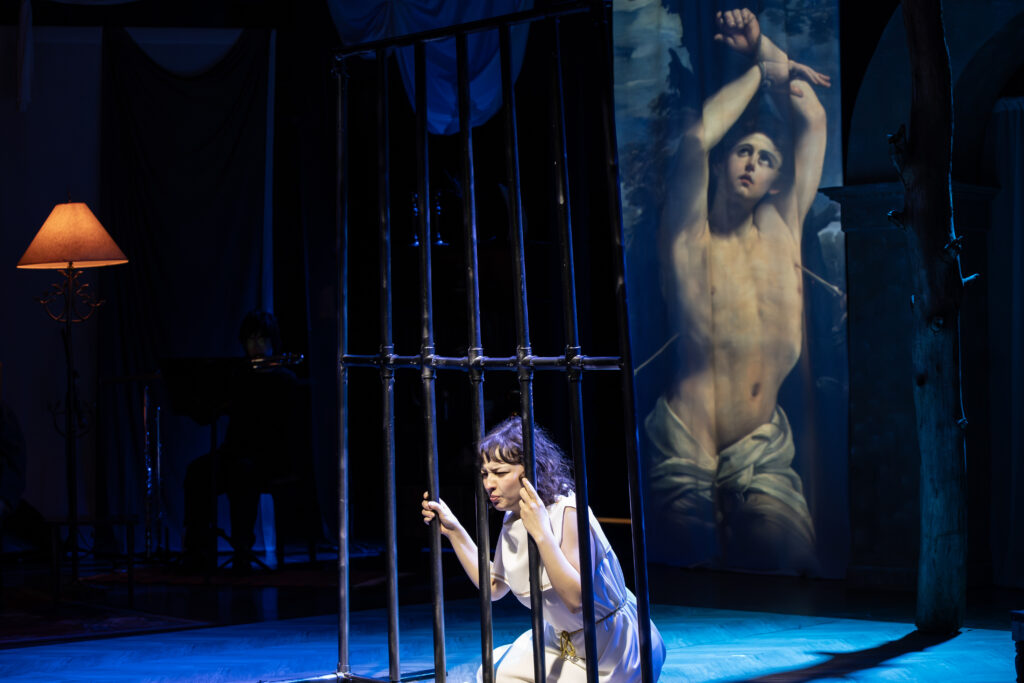
Alessandra Lopez in Antigone in Analysis, March 19, 2026. Photograph by Marina Levitskaya.
For a few weeks this spring, you couldn’t swing a thyrsus in New York without hitting a play about Antigone. Perhaps it started with Robert Icke’s Oedipus, the Broadway production from February, which featured a modern-day Antigone as a sulky teen who little suspects that her father is also her brother. Soon after, four different theaters across the five boroughs staged their own renditions of Sophocles’s famous play, reimagining his two-thousand-and-five-hundred-year-old mythic figure as, variously, a pregnant teenager, an analysis patient, an incestuous home renovator, and a freedom fighter in a fascist regime in the future. The latter, in a bid to underscore the theme of rebellion across the ages, went so far as to include audio from the ICE raids in Minneapolis.
It’s not hard to hazard the reasons for the renewed popularity of the Theban protestor who challenges the authoritarian rule of her uncle, King Creon, and is subsequently put to death. (One production titled its director’s note “Caution to the Resistance …”) But it is curious that, among the many iterations of Antigone now at hand, each has striven so forcefully to recast and reimagine her for the modern era. Virginia Woolf once wrote that Electra, another famous Sophocles ingenue, perpetually “stands before us like a figure so tightly bound that she can only move an inch this way, an inch that.” And yet contemporary theater seems to see Antigone as a character who can be moved quite freely—in the case of the Flea’s recently closed production, doubly so. The director, Alex Pepperman, based his adaptation not on the original text but on a script by Jean Anouilh, first staged in Nazi-occupied France in 1942. Where Anouilh’s Creon subtly echoed the spineless authority of the Vichy regime (so subtly that the play eluded the Nazi censors), Pepperman’s updated references are somewhat less oblique. “The time is 2030, and the neo-fascist Regime 47 has entered its Third Term in The United States,” his director’s note reads. “The 47th President continues to rule over all, now hailed as Supreme Leader.”
The other modern Antigones have perambulated nearly as far from their Greek eponym. The Public Theater’s Antigone (This Play I Read in High School) makes an unmistakable bid for contemporary relevance with its subtitle. The “I” of the parenthetical is not Antigone but the Chorus, voiced by a diffident cardigan-wearing woman (Celia Keenan-Bolger) who stands in, at once, for the classical Greek chorus; Creon’s wife, Eurydice; and, implicitly, the playwright. In an early scene, the Chorus confesses that when she first read the play in the titular English class, she had been put off by Antigone, recalling a girl who spoke too freely, too absolutely. (“I wasn’t feeling it,” she tells the audience, “I mean, here was this girl who says whatever she wants, whenever she wants, even on pain of death.”) And yet she was prompted to revisit the story after seeing it in the hands of a twitchy teenager on a plane, who didn’t “seem to like it very much.” The teen confirms: “Is it even about her? It seems like it’s all about her brother’s body. A man’s body.”
The desire for a play “about” Antigone and her body is ostensibly the catalyst for this one, but when Antigone (Susannah Perkins) appears, she is quick to clarify that she is not the Antigone from Greek myth—despite inheriting the name, the family, and the foreboding sense of family cursedness. This Antigone is much more impulsive than her forebear: we find her, in an early scene, drunk and chatting up a bartender named Achilles (Ethan Dubin)—not the Greek hero; he just happens to share the name—about the coronation of her uncle, which she missed. The Thebes around her is an abstraction refracted through present-day anxieties: a nervous polity, a sense of civic unraveling, and this newly crowned ruler, anxious to make his mark as an orator. (His coronation speech, as Achilles tells Antigone, went on into the evening). Creon (Tony Shalhoub) is something of a straw-man dictator, set on reviving Thebes with a return to family values. He believes he has “been appointed to do no less than resanctify the value of life itself,” a commitment which proves rather literal. He bans abortions—an unfortunate twist for Antigone, who, we learn, is pregnant with his grandchild.
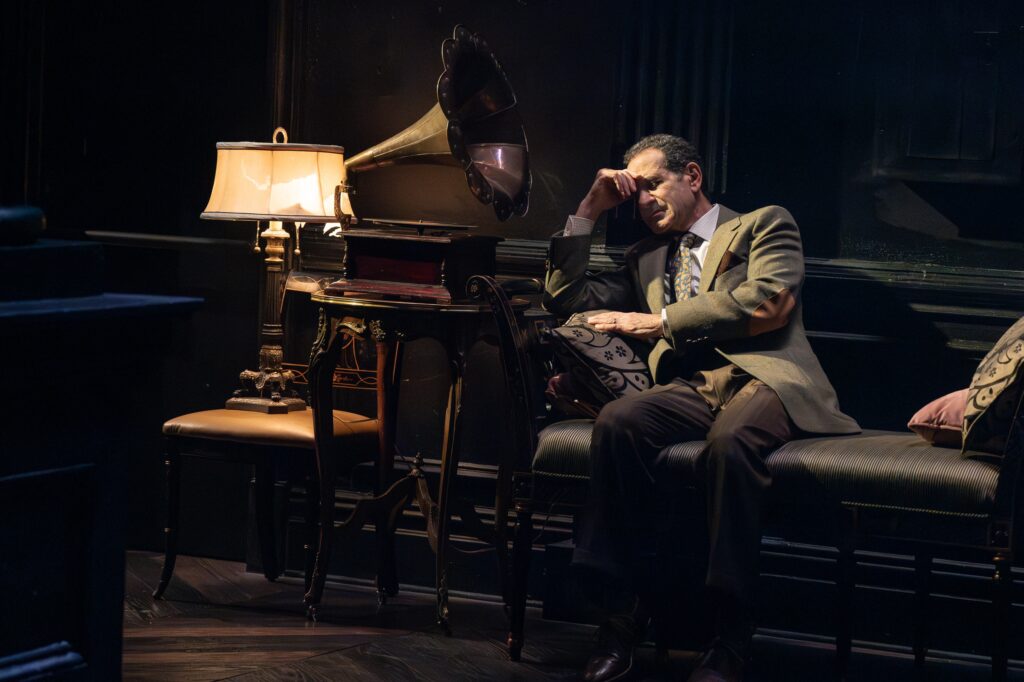
Tony Shalhoub in the world premiere production of ANTIGONE (THIS PLAY I READ IN HIGH SCHOOL) by Anna Ziegler and directed by Tyne Rafaeli. Photograph by Joan Marcus.
This protagonist, in other words, becomes a rebel not because she chooses to give her brother a proper burial against her uncle’s orders but because she chooses to terminate her pregnancy—a crime now punishable by death. The playwright, Anna Ziegler, is clearly drawn to the etymological pun embedded in Antigone’s name—as the script notes, the word “can mean against (anti) procreation (gone).” The shift is conceptually intriguing but dramatically vexing. The more the play departs from the outlines of Sophocles’s tragedy, the more the classical scaffolding begins to feel ornamental, even arbitrary. A drama in which a woman wrestles with an unplanned pregnancy is very different from a play in which she weighs her duties to one dead sibling over a living one. In the Sophocles, Antigone’s action is anchored in both a bond with her brother and a stark calculus about what is owed to the dead. Ziegler’s version replaces that reckoning with one oriented toward autonomy and the ethics of bringing a child into a damaged world. As Antigone sputteringly tells her sister, Ismene (Haley Wong), “To be a mother—right now. To bring a child into … After everything that … It just doesn’t feel…”
The motivations of Ziegler’s Antigone seem intermittently unmoored, even glib. When Ismene urges her to keep the child and, by extension, her life, she nonchalantly likens having a baby to passing along “a joint at a dimly lit party.” The character’s tonal volatility is compounded by that of the play, where scenes of high-stakes deliberation are interspersed with sketch-like comic interludes—often involving three policemen who speak in overlapping dialogue with exaggerated Boston accents. When one of them remarks that “it’s like we walked into someone else’s book,” the observation lands with unintended precision. At its core, Ziegler’s play is concerned with a question about inheritance—what it means to receive a story already saturated with meaning and to attempt to live differently within it. While Ziegler’s Antigone resists the script she has been given, the play itself seems less certain about how to rewrite it.
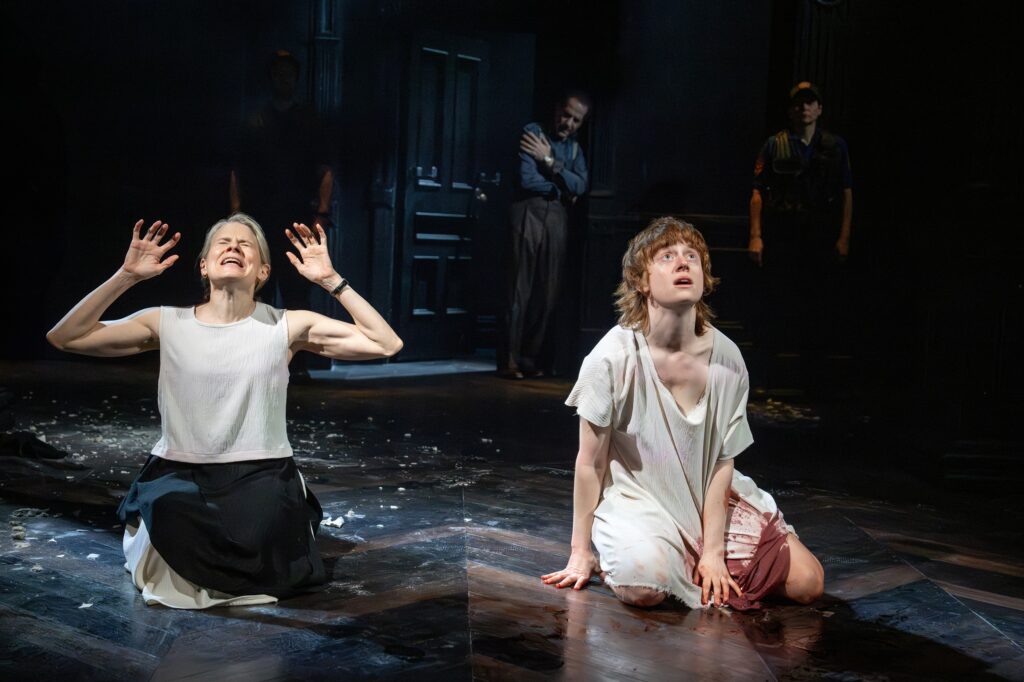
Celia Keenan-Bolger and Susannah Perkins in the world premiere production of ANTIGONE (THIS PLAY I READ IN HIGH SCHOOL) by Anna Ziegler and directed by Tyne Rafaeli. Photograph by Joan Marcus.
On the other side of the spectrum sits Alexander Zeldin’s The Other Place, a work putatively inspired by Sophocles’s Antigone and yet so slight and self-contained that its kinship with the Greek play can scarcely be felt. There are no overt invocations of Thebes, no would-be suitors for Antigone, no sweeping gestures toward myth, only faint structural echoes: a fractured household, the specter of incest, an obstinate uncle, a young woman whose attachment to a family member resists the prescriptions of others. In this production—whose spring run at the Shed can now be streamed on the National Theatre at Home platform—Zeldin’s Antigone analogue, Annie (Emma D’Arcy), returns to her childhood home for the first time in years. Her father had committed suicide when she was a teen; Annie, who had discovered his body, has been estranged from her family ever since. Her return now has been prompted by her uncle Chris (Tobias Menzies), who has decided to inter her father’s ashes. Chris, who has assumed ownership of his deceased brother’s house and has overseen its renovation, feels that a burial would settle the dead into the earth and allow the living to move on.
For her part, Annie, not yet ready to move on, wants her father’s ashes to remain within the house. The circumstances of his suicide introduce a psychic rupture that the play circles without fully exploring. No motive for the suicide is supplied and no mention is made of Annie’s mother. The family tension instead revolves around the taboo of incest, which Zeldin relocates from Oedipus and Jocasta onto the dyad of Annie and Chris. Their interactions veer into territory that feels deliberately disquieting. In one scene, Annie spits into Chris’s open mouth as he kneels before her; in another, he searches her by stuffing his hands into her pants.
But it is hard to know what to make of these moments, or how they fit into the play’s broader emotional logic. In an early scene, Annie insists “that more people are harmed from within the family than outside of it,” and, in its suggestion is that Annie has been groomed or preyed upon by her uncle, The Other Place has the whiff of a #MeToo drama. Yet the contours of Annie’s relationship with Chris are far from clear—is it coercion, misplaced longing, or some unstable mixture of both? In one moment of apparent passion, she and her uncle kiss under a red tea cloth that he has draped over his head, as if to hide their shame from the gods. The stage directions note that this “is the live consummation of what has been for years a secret,” though in the play that remains unsaid. This Annie is a far cry from Sophocles’s heroine, whose clarity of purpose burns through every prohibition; with Annie, one gets the perverse sense of someone burning through prohibitions in order to find a clearer sense of purpose. By the end, however, her desires seem to remain opaque even to herself. Where the classical Antigone strides toward her living tomb with a kind of terrible lucidity, this one recoils and finally vanishes by her own hand, after Chris’s partner, Erica (Lorna Brown), an underwritten Eurydice figure, catches Annie and Chris necking in the kitchen. Her suicide arrives not as an act of principled resistance but as something closer to emotional collapse.
Like Ziegler’s Antigone, Barbara Barclay’s Antigone in Analysis carries with it the baggage of all the inherited ideas about the Greek princess. Ziegler’s script includes a page of paratextual quotations from the likes of Albert Camus, Václav Havel, and Helen Morales. The play, produced by Peculiar Works Project and recently staged at La MaMa, invites us into a metaphysical salon where Georg Wilhelm Friedrich Hegel, Judith Butler, Søren Kierkegaard, Luce Irigaray, and Jacques Lacan circle Antigone like disputatious vultures, pecking at the play’s meanings while intermittently donning its various roles.
The production’s most conspicuous deviation is to elevate Jocasta into Creon’s place—she’s crowned queen and escorted to a throne by Butler and Irigaray—reframing the conflict as one between mother and daughter as well as ruler and dissident subject. (Barclay has said that the work began as a way for her to explore her own relationship with her mother, before blooming into a larger play about blindness in Sophocles.) The tension here derives from Antigone’s open antagonism toward her mother’s complicity in committing incest with her son turned husband (Antigone Agonistes could be an alternate title). Her bluntness is characteristic of this hourlong play, which also makes the mystifying choice to stuff lines from Hamlet into the mouth of its titular character. “O shame, where is thy blush?” Antigone asks her mother; Jocasta, in turn, spouts lines from Lady Macbeth’s “unsex me here” speech.
Arrayed like tennis doubles partners at the corners of a rectangle, the philosophers bat their claims across the stage with competitive zeal. Kierkegaard’s belief that “women should stay at home and bear children—as many male children as possible” collides with Butler’s insistence on gender as performance (an idea the play implicitly endorses), while Irigaray presses for a specifically feminine language that resists absorption into male frameworks. I was too distracted by the gray mass that fails to pass for hair on top of Hegel’s head to make much sense of his musings. At one point, she is subjected to a mock clinical examination, as though the play were literalizing centuries of theoretical scrutiny. The kindest thing one could say about this work is that it has, to quote Bernard Williams, “one thought too many.”
On the question of Antigone’s motivations, the philosophers and psychoanalysts never converge; her rebellion is alternately framed as ethical necessity, psychological compulsion, gendered performance, and overdetermined resistance. What remains palpable, despite the din, is a sense of Antigone as a perennial provocation: not so much a peerless as a peerful figure containing multitudes, to judge by all the recent adaptations featuring a teen refusing to adapt to the times. In his forthcoming book Antigone as Political Philosophy, the philosopher Gregor Moder suggests that what appeals most to contemporary audiences about the Greek noblewoman is her ethical rectitude, or “attitude,” even as her determination to bury her dead brother perplexes and leaves some people cold. “Maybe Antigone sets an example precisely with the substantive emptiness of her deed, with the absence of any comprehensible intention, with a hiatus or gap in which we can set our own stake and our own potential subjectivity,” he writes. If Barclay’s play buckles under the weight of its relentless philosophizing, it nonetheless testifies to the fact that Sophocles’s heroine refuses to stay buried, no matter how many layers of theory are piled atop her. Butler speaks for all four playwrights when they note that “Antigone haunts us, a hungry whispering that our past is still with us.”
Rhoda Feng is a freelance writer in Washington, D.C. She has covered books and theater for 4Columns, Artforum, frieze, the Nation, the Boston Globe, and the New Republic.