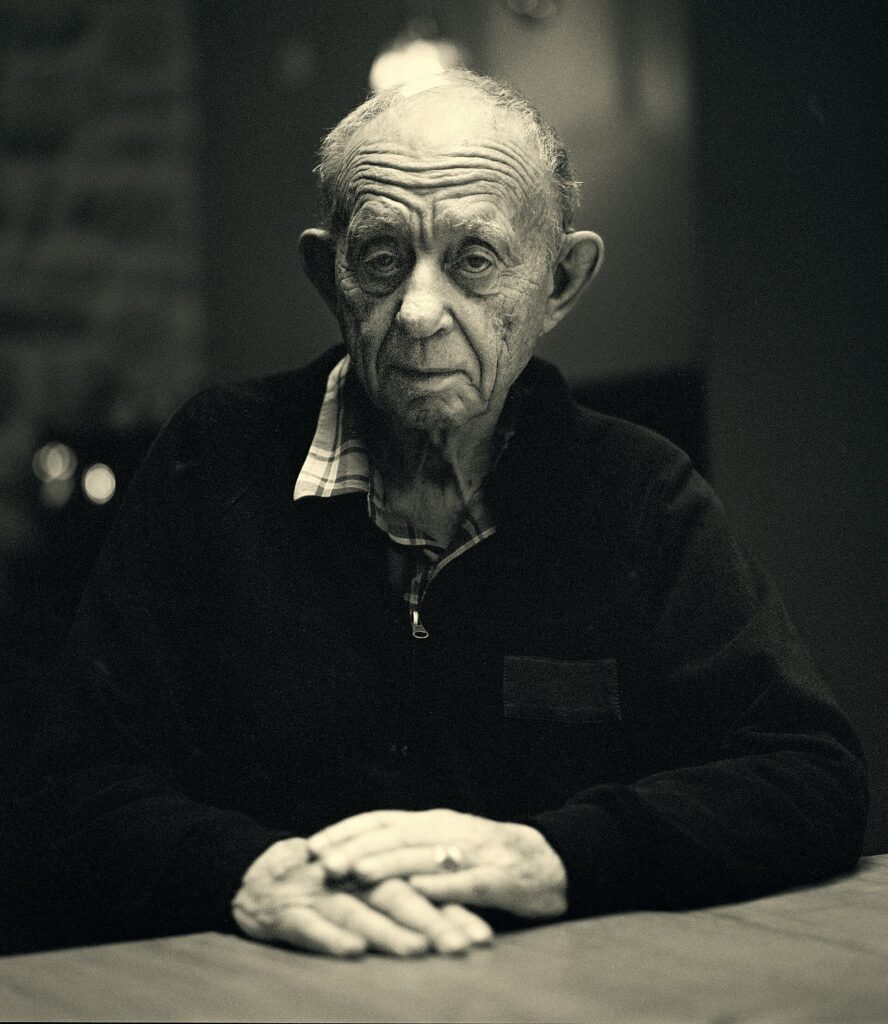
Photograph by Antoine Yar, via Wikimedia Commons. Licensed under CC BY-SA 4.0.
.jpg)
So uninterested was I in coming out of the closet at the dawn of the twenty-first century that the thought of spending freshman year on death row seemed more appealing. This was September 2000, during my first semester at Duke. I was anxious about sex and awkward around other boys I thought might be gay. I avoided the one out guy in my hall, instead spending many a late night interrogating the evangelicals who dominated our dormitory. They were friendly but fervent and unfunny, and they wore their heterosexuality as proudly as the chunky wooden crosses around their necks.
The death row project was the brainchild of a criminal defense attorney who was friends with my photography professor. The attorney, whom I’ll call Jack (like most people in this piece, that was not his real name), was looking for students to travel around the state taking portraits of his clients’ families. The students would then venture to Central Prison in Raleigh to pass their work off to the inmates, all of whom were awaiting execution and rarely saw their parents, wives, or children. It takes a particularly inspired imagination to not only come up with a project like this but to trust that three college freshmen, of all people, could be the ones to lead it. Jack had a sardonic twinkle and hid his compassion under a rumpled blazer, which, the first time I met him, sported a mustard stain. I signed up right away.
Jack’s firm represented a dozen capital offenders, and he hoped we’d each work with one. When we met in his office, he gave us a list of each man’s name and ID number and explained in vivid detail the crimes they’d been convicted of committing. One man stabbed a teenage girl sixty-four times for no apparent reason (“I’d skip him,” Jack suggested). “So,” he said after he finished describing the twelfth man’s felonies, “who y’all wanna see?”
Over the next three months, I met a handful of inmates, developed a rapport with a couple of them, and carefully avoided others. One wrote us nice letters in between visits. Another sent a girl on our team a death threat on which he signed another man’s name, only to learn that the inmate he was trying to frame was illiterate. Frank, whom I visited most often, liked race cars and football. He had a gentle, almost childlike demeanor, the result of some form of intellectual disability.
Frank’s niece, Leah, took care of him before he went to prison, and it was her family I was assigned to photograph. Leah lived in a double-wide in a small town an hour and a half south of Durham, with her three kids and a Jack Russell terrier. A few visits in, the Jack Russell wasn’t there anymore but this was never discussed. I understood early on that Leah was not the sort of woman for whom “By the way, what happened to your dog?” would be greeted with a warm response.
Leah wore oversize T-shirts and jean shorts and kept her curly red hair just above her shoulders. Her default expression was a sort of low-key snarl: like her disappeared dog, she rarely bit strangers but wanted to be sure they knew she could. Her children, it was clear, were her life’s work, and they followed her commands with the poker-faced efficiency of tiny soldiers. Eddie, her eldest, then eleven, could cook dinner, fold laundry, and drive stick. Her other two were younger and less interested in our project, but perfectly happy to let me snap pictures as they jumped on the trampoline in the front yard.
Over that fall, I forged what might be described as an uneasy alliance with Leah. I wouldn’t say she liked me, exactly, but she liked my photos of her kids and seemed to find my presence pleasantly bizarre. If she clocked me as gay, she didn’t let on. What I liked about Leah was that she wasn’t one to ask. She had three kids, no husband, and a full-time job. Determining my sexual orientation was not on her to-do list.
If her tolerance for me morphed gradually into a grudging respect, I think it was in large part because we both possessed a sense of humor about the general strangeness of our world. One day she dropped me off with Frank’s extended family, people she hated with such intensity that she didn’t even get out of the car to say hello or to explain who this stranger with a camera might be. The extended family lived in a rickety compound in the woods and roamed around on ATVs. When I asked what they were grilling in their firepit, one toothless woman sneered, “Buzzard. You want some?” If these rough-and-tumble relatives no longer amused Leah, my excited account of the experience certainly did. She smirked. “You liked them that much, did you?”
The next semester, now fashioning myself an aspiring documentarian, I enrolled in a film workshop in which each student would make a five-minute short about a local family. I proposed the project to Leah and by February I’d substituted my Kodak T-Max 400 for a box of mini DVs. Soon I was filming Leah at the pizza place where she worked and Eddie at lunch in the school cafeteria. We drove together to Central Prison, and though I couldn’t film inside, Leah tearfully recounted the visit afterward as Eddie filled the car with gas.
The filmmaking course was offered through Duke’s Center for Documentary Studies. Our professor enforced strict rules about how and what to shoot. We were allowed to record only six hours of footage, and our finished product couldn’t include voice-overs, interviews, or any soundtrack, unless music happened to be playing as we filmed. The films we studied in the class were variations on this “direct cinema” style, employing no re-creations, no one directly addressing the camera, and little hint of didacticism: just scene after uncomfortable scene.
The filmmaker who made the biggest impression on me was, unsurprisingly, one of the most influential and celebrated documentarians operating in this mode: Frederick Wiseman, who died in February at ninety-six. Our introduction to him came via his 1968 film High School, which depicts life at Northeast High in Philadelphia. Shot over a five-week period, the documentary is, as Newsweek once described it, a study in “the overwhelming dreariness of administrators and teachers who confuse teaching with discipline.” Years later, I remember it in large part because of a scene in which a gynecologist lectures an auditorium full of rowdy boys about sex, informing them that he has seen girls whose “hymens were so small that I couldn’t pass a finger through them” before adding, “I happen to be a gynecologist and get paid to do it.” As with many memorable moments from Wiseman films, the general strangeness of our world is on full display.
The more I learned about Wiseman, the more I hoped to emulate his pioneering style. His first film, Titicut Follies (1967), is about a Massachusetts state hospital for the criminally insane. To imagine a hospital administrator agreeing to this sort of project in a post-Titicut world speaks to the devastating impact of Wiseman’s work; anyone who had seen anything like it before surely would’ve said, You can see yourself out.
Viewers witness inmates made to strip in public by hectoring guards, and dark, dungeonish cells that look like something out of a horror movie, which, in a way, they were. In one of the film’s most harrowing sequences, a doctor, cigarette dangling between his lips, forces a long feeding tube up an emaciated patient’s nose. For his part, Wiseman was, alas, eventually asked to see himself out: the film was more or less banned for decades, after the state argued in court that it violated patient privacy, though Wiseman had received permission to film at the hospital. It only became widely available in the early nineties.
In the decades following Titicut Follies and High School, Wiseman became the most incisive chronicler of America’s institutions. Near Death (1989) documents the Medical Intensive Care Unit at Boston’s Beth Israel Hospital. Law and Order (1969) follows police officers in Kansas City, Missouri. Many of the film’s titles speak for themselves: Juvenile Court (1973), State Legislature (2007), Racetrack (1985), Zoo (1993).
The films are immersive. They sometimes begin with shots of the surrounding streets, but once you’re inside you’re there. Wiseman’s subjects behave badly and show tremendous kindness; they try to do right and fail (or succeed); they are often very funny. None of the characters are identified with title cards, and it’s up to the viewer to follow along closely enough to know who’s who.
In class we’d learned that Wiseman operated with a small crew and often served as his own sound recordist, holding the boom mic himself. The lesson was to not only look but listen. Paying attention required our whole selves.
My attempts at imitating Wiseman were mixed at best. Leah tolerated my tagging along on errands and hanging around her living room during the six weeks of production. She became angry with me only once, when, after a long and emotional day driving to and from the prison, I shot footage of her mopping the bathroom floor. “Get that thing off me,” she hissed, in the same vicious whisper she used on her children when they misbehaved.
I always showed up when I said I would, leaving campus early on Saturday mornings and often staying until dark. Of course, I had my reasons for committing to the project with such intensity; the chance to focus on Leah and her family was a welcome reprieve from spending my weekends pondering my place in the world.
But if my visits were born, in part, from avoidance, they were also a study in the possibilities that open up when paying close attention to someone else. In class, we’d talked about how comfortable Wiseman was forcing his viewers to stay focused on one shot. One night, I’d tried to emulate his patience, keeping my camera on Leah, who played a game on her desktop, while her kids darted in and out of the frame. She oscillates between good-naturedly teasing them and barking orders, which they follow, though she rarely takes her eyes off the computer monitor. The result is somehow both very Leah and very me: a wry glimpse into her complicated power.
At the end of the semester, we screened everyone’s films in a small theater on campus. Leah couldn’t make it, but I sent her a copy and she seemed to approve. We agreed we’d meet back up after I returned from summer break. But it’s funny what college can do to a closet case. By early sophomore year, I’d come out to my family, made some gay friends. The drive to Leah’s started to feel less like an escape and more like a nuisance, and while I’d visit Frank at Central Prison on occasion, the long waits and multiple checkpoints started to grate.
That fall, I agreed to go to one of Eddie’s football games but canceled at the last minute, then canceled a second time. I emailed Leah to apologize and never heard back. A month later, I called Leah and the woman on the other end told me that the number had changed. “Is this Leah?” I asked. The woman said nothing and hung up.
***
In September 2006, I moved to Austin, Texas. I knew only a couple people in the city, so when I saw a listing for a six-week boxing class, I thought it might be a good way to make friends.
The class was at Lord’s Boxing Gym, a gritty Austin institution then located behind a medical supplies warehouse on a utilitarian stretch of North Lamar Boulevard. Inside, boxers jumped on tires, tossed medicine balls, and skipped rope in whatever space they could find. Men and women knocked around heavy bags swaying from thick chains, and, in the main ring, fighters in head gear and leather body cups sparred. The gym’s owner, Richard Lord, acted as trainer, judge, and referee. It was like no place I’d been before.
In the evenings, when I trained, the gym was crowded, loud with the thwap of wrapped fists on speed bags, sneakers squeaking, the beep of digital fight clocks. Lord’s had no air-conditioning, and from Memorial Day to Halloween it wasn’t unusual for the thermometer on the wall to read 97º or 103º. Most people brought an extra T-shirt or two, knowing they’d have to change midway through their workout.
When sparring wasn’t happening, Richard, small and strong, was everywhere: weaving between heavy bags and offering advice on form and stance, pitching new members in his cramped office, wheeling past the ring on an old unicycle or hopping around on a pogo stick. He wore a braided rattail, a fanny pack, and a portable phone clipped to the side of his shorts. Whenever it rang, he’d answer “Boxing” and cradle the receiver under his neck, as he continued whatever he was in the middle of doing. We all prayed the phone wouldn’t ring as he led us in crunches because sometimes he’d forget when the set was supposed to end and keep going. Two minutes, three minutes, crunching, crunching, and jabbering away.
The boxers at Lord’s were impossible to stereotype: high schoolers preparing for local tournaments; frat boys training for campus fight nights; professionals like Jesús “El Matador” Chávez and Anissa “The Assassin” Zamarron, both former world champions; retirees. They were Mexican and Cuban, Black and white, Chinese, Indian, Irish. There were lawyers and construction workers and ex-fighters with stories to tell and time to kill. Sometimes it felt like everyone in Austin was at the boxing gym, all at the same time.
I started in mid-October, slow on the jump rope, unable to find rhythm with the speed bag, nauseous after my first abs routine. After class that first night, I watched a YouTube video to remind myself how to wrap my hands, then returned two days later for another round. By the end of the first week, I was in love, less with the sport than the scene.
My ardor was a little more complicated than just finding Lord’s a fun place to be. Then twenty-four, I’d moved to Austin for the most Austin of reasons—no reason, or at least that was my go-to line. I’d come from Brooklyn, where I’d headed after college; as a newly liberated gay guy with writerly aspirations, it had felt like the place to be. But I chafed at the notion that there were places I belonged and places I didn’t. I knew that some of my most formative college experiences, including the project with Leah, never would’ve happened if I’d felt otherwise. Austin was cheaper than New York and a college mentor had told me I’d like it there. Still, part of the attraction was the vaguely forbidden notion of living in Texas. The boxing gym, like the state, appealed to what I told myself was a conviction but was in fact more like a hope, that I could be gay and go anywhere I pleased.
This all would’ve been a surprise to the denizens of Lord’s. During the six-week course, I rarely spoke, the training itself as intimidating as the wild mishmash of patrons was exhilarating. Even after the class ended and I started paying a monthly fee, I remained a bit shy. After a while, people started noticing me, though not for my boxing prowess or, as I would learn, for much of anything. You don’t become a gym regular because you’re the fastest or the strongest. You become a gym regular because you keep showing up.
One day as I worked the heavy bag, I was surprised to find one of the pro boxers observing me, and even more surprised when, after the fight clock beeped, he gently explained what I was doing wrong. Friendly nods morphed into small talk between rounds; I went out to dinner with one fellow gymgoer and to the movies with another. People began trying out nicknames for me: “New York,” which made little sense given my short tenure there; “A-List,” after a photo of me drunk at a holiday party wound up in an online article about buzzy social events of the season. Eventually, everyone came to some silent consensus that I wasn’t a nickname person and started calling me Lucas.
***
In early 2007, some months after I’d first set foot in Lord’s, a three-man film crew showed up to make a documentary about the boxing gym. I assumed their ringleader was the cameraman, a slightly ruddy-faced fellow with the hardy bearing of a foreign correspondent. The sound guy, owl-eyed and a bit gloomy, seemed weirdly old for the job. The third, and youngest, lugged equipment behind the other two.
The filmmakers didn’t engage much with us and didn’t conduct any interviews. After a few days most people seemed to forget they were there. I’d moved on from any attempts at filmmaking by then and didn’t find their presence especially remarkable. As I learned soon after joining, Lord’s was a well-known fighting haven, Richard a person of note. In the eighties, he’d trained David Bowie ahead of his Serious Moonlight Tour; in my era, a couple of the regulars from Friday Night Lights would occasionally pop in for the afternoon abs class. Lord’s old-school grit made it a hotspot for student photography projects and the occasional short, not unlike the one I’d shot with Leah. A documentary film crew, even a professional one, was just another day at the gym.
A few weeks into the filmmakers’ shoot, I was in between rounds on the speed bag when I noticed a sign taped near the entrance: “If you do not wish to be filmed while working out, please contact Frederick Wiseman.”
“Is Frederick Wiseman, like, Frederick Wiseman?” I asked Richard.
Frederick Wiseman was indeed Frederick Wiseman: in his late seventies and shooting his thirty-eighth film, Boxing Gym, which would premiere in 2010. The cameraman was his longtime cinematographer, John Davey. As Wiseman had on previous films, he ran sound, leading his crew with his microphone, listening and watching, deciding where to shoot next.
Wiseman and his team spent about a month and a half shooting Boxing Gym, moving around the tight quarters seamlessly, almost invisibly. Given my own history with Wiseman’s work, one would think I’d have vivid memories of his time at Lord’s. But I was too starstruck to ever approach him (and knew, too, that, if I did, I would be approaching him not as an admirer but as a subject—a role I was keen to avoid). Even if I’d decided to try, I don’t know that I’d have gotten a chance: I rarely saw him without his headphones on, boom mic in hand. Over the many hours I was in the same room as Frederick Wiseman, I’m not sure I ever heard him speak.
When I recently asked some old gym friends what they remembered about Wiseman, the consensus was the same. “I don’t remember him talking to anyone,” texted one friend, who added that Wiseman seemed interested in everyone except those who occasionally “jockeyed for his attention.” Another could describe him physically but had no idea what he sounded like: “I want to give him a French accent, but I don’t know why.” (He did not have a French accent.)
A few years after filming wrapped, many of us went to an early screening. My memory is that the assembled greeted Boxing Gym with both recognition and bafflement. (“I liked it,” a friend told me, “but was that a movie?”) My own first reaction was relief at learning that I didn’t appear in it; as much as I’d improved in my years at the gym, I wasn’t sure I needed my workouts immortalized on the silver screen.
In truth, I don’t think Boxing Gym made much of an impression on me at the time. Back then, I was sharing a house with a pal from the gym and her boyfriend, an amateur boxer, and working out at Lord’s regularly. I was still so in it that I was watching more to see who showed up and what they said or did than appreciating what the work was doing.
It wasn’t until after Wiseman’s death, on February 16, that I watched Boxing Gym again. Much has been written about Wiseman’s dissection of institutions, but in the case of Boxing Gym, I think the more apt word is community. What struck me first is that almost no one is wearing headphones, which would prevent fighters from hearing the fight clocks, and one another. (The radio, a constant presence in my days at Lord’s, is also off—a necessary concession, unless Wiseman’s sole interest was creating a time capsule of what was playing in spring 2007 on 93.7 KLBJ.) No cell phones appear on screen either; Apple would release its first iPhone later that year.
The film captures everything reviewers said it captured when it came out: the musicality of boxing; how, despite the violence of the sport, Lord’s represents, as the Times critic Manohla Dargis noted, an unexpectedly “pacific vision.” What I didn’t notice the first time I saw Boxing Gym was how much attention Wiseman pays to people paying attention to each other. Trainers closely monitoring trainees; a dad, on a break from the heavy bag, crouched in front of his baby, who stares up at him from a carrier on the floor. In one lengthy sequence near the film’s end, two men spar in the ring as a half-dozen guys look on with almost unblinking intensity. Maybe they’re trying to learn from the boxers, or evaluating their skill, or just curious what will happen. Whatever they’re thinking, they are giving the men their deep attention, and the energy in the room is unmistakably communal, the close-ups on the spectators as charged as the action in the ring.
Watching Boxing Gym all these years later, I was reminded of a quote I’d come across in an interview with Wiseman: “The ‘real’ film takes place where the mind of the viewer meets the screen.” Wiseman’s movies fascinate us in part because he demands the same attention from his audience that he affords his subjects, the same attention that, in Boxing Gym, they afford each other. You can’t scroll on your phone and watch Wiseman. You have to show up and listen. Wiseman offers us his mind in exchange for our own.
***
I stopped going to Lord’s in 2011. I’d moved to a different part of the city, and while an earlier incarnation of myself might’ve continued making the trek, by then I was firmly settled in Austin with a serious boyfriend, my boxing friends so enmeshed in my life that I no longer needed to go to the gym to find them.
It was during the move that I rediscovered the photographs I’d taken of Leah and her family more than a decade before. A few times, I considered reconnecting with her, maybe offering to send her copies, but I always chickened out. I’m not so narcissistic as to believe our abrupt ending was a traumatic event for her, but I do wonder what it felt like to be the object of someone’s sustained attention, even a college freshman’s, only to have them stop showing up. She died in 2014 at the age of forty-five; her obituary reveals no cause of death.
These days, my husband and I are mostly focused on our seventeen-month-old, who is inheriting a world of limited attention spans and fractured community. When I go to the gym now—the local Y—my earbuds are in before I even walk through the door. Most of the time I forsake the gym for the Peloton. So much of personal fitness now emphasizes the personal, experiences altogether devoid of other people.
I suspect that’s why, in the weeks since I rewatched Boxing Gym, there’s one scene I keep returning to. The gym is almost empty except for two fighters—one man, one woman—shadowboxing in the ring. They keep their distance: they’re fighting the air, not each other. But we get the sense they’re egging each other on, holding each other up. When the woman falls from frame—is she tiring?—the man keeps at it. But no, she hasn’t stopped, either, and soon they’re both fighting harder than before, grunting and breathing heavily. For over a minute, Wiseman follows only their lower halves: two sets of legs moving in different directions but always, somehow, in concert. Some critics have described this scene as erotic, and they are not wrong. But it also captures something simpler and more platonic; two athletes whose persistence is tied to awareness of the other.
Filmmaking, like boxing, is a team sport masquerading as an individual one: it’s a give-and-take between artist and subject, between artist and audience. Wiseman famously loathed explaining his films. But his ideas are right there in the ring. Hold a shot long enough and you reveal something about the person in front of the camera, and the person behind it.
Lucas Schaefer’s debut novel, The Slip, was one of the New York Times Book Review’s 100 Notable Books of 2025. It won the 2025 Kirkus Prize for fiction and was a finalist for the National Book Critics Circle John Leonard Prize. Schaefer’s work has appeared in The Baffler, Slate, and One Story.