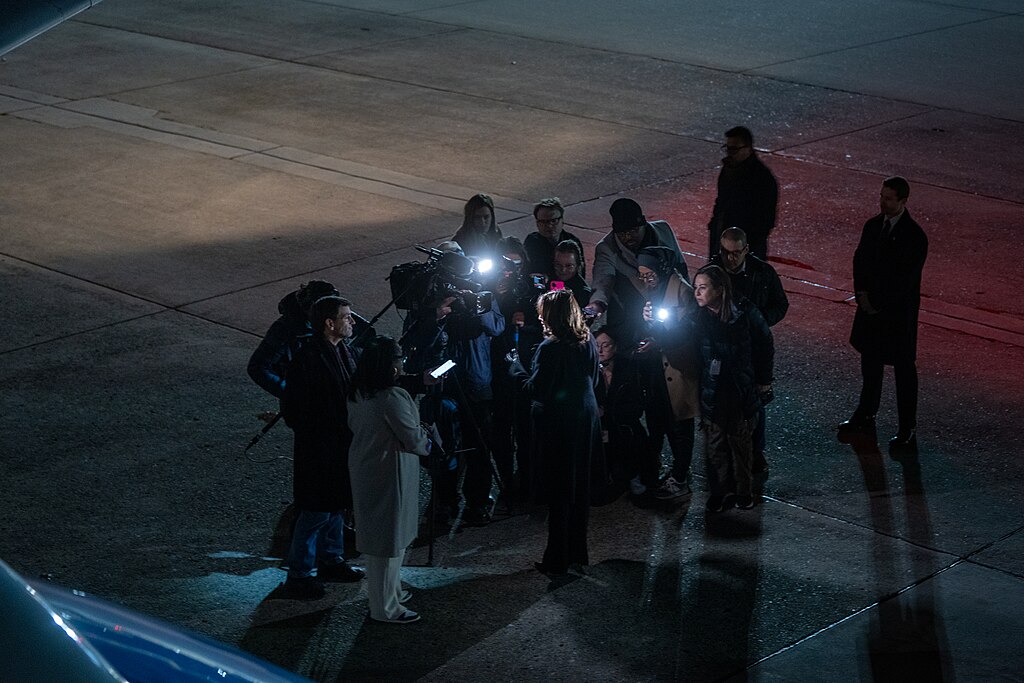
Kamala Harris shares a statement to reporters following the mass shooting at the Kansas City Chiefs parade before boarding Air Force Two at Joint Base Andrews, Wednesday, February 14, 2024, in Maryland. Official White House Photo by Lawrence Jackson. The White House, via Wikimedia Commons. Public domain.

I have begun to suspect that I am not the main character. I spend my days watching history unfold on the screen of my phone. History, of course, is a story: a narrative sequence of causes and effects. Right now it seems to be a story about intolerable violence, something from which I am, I know, profoundly remote insofar as I continue to tolerate it. This is not very protagonistic of me. Main characters, surely, do not feel the world to be distant and bewildering in its senseless horror. They do not feel the story of history to be totally disconnected from their personal, concurrent experience of being alive. Main characters, after all, drive the plot.
Conveniently, real-life main characters love to write about themselves, so there’s plenty of material from which I might learn how to achieve main character status myself. Material, for example, like George Templeton Strong: Civil War Diaries and 107 Days, two recently published diaristic texts. Both of these meticulous nonfictional accounts of living through history are said to be very novelistic. One is “remarkably vivid and suffused with novelistic detail” such that its author “emerges as an unforgettable, three-dimensional character.” The other, we’re told, “reads like a suspense novel” in that it has “a novelistic feel” and “the pace of a page-turning novel.” It would seem that these writers—George Templeton Strong and Kamala Harris, respectively—are main characters because their realities were, even during times of crisis and dissolution, like books. Things, in other words, make sense when you’re a protagonist because you live inside a novel. The present operates with a narrative purpose and a unifying logic by which the lives and actions of individuals are bound together and to the world at large such that it is possible, as any main character innately knows, to do something important.
It turns out, however, that George Templeton Strong did basically nothing. The Library of America, which published a selected edition of Strong’s Civil War–era diaries in January, may nonetheless be pleased to know that Strong is, I think, very relatable in his insignificance. Born in New York in 1820, Strong was a lawyer who is remembered by history only because he made himself extraordinarily easy to remember. Nearly every day for more than forty years, Strong wrote a detailed account of his thoughts and activities in what he called his “private journal.” This document of more than four million words was discovered five decades after Strong’s death in 1875, and it now provides a unique glimpse into the past when it was the present.
Evidently the present has always been kind of pointless and annoying. “Atrocious headache all day. In bed till dinner time,” Strong reports in the first entry of this new collection. The shadow of history, however, passes over Strong’s present just four days later. The diarist wanders Lower Manhattan “alone & tired,” then returns home and writes that November 6 was “A memorable day—we do not know yet for what. Perhaps for the disintegration of the Country.” Indeed Lincoln’s victory in the 1860 presidential election that day would more or less inaugurate the most significant historical “event” of Strong’s lifetime. And what, then, would our main character experience and in real time record as his country, he knew, was “turning out raw material for History very fast”?
The author of these Civil War Diaries, we quickly learn, experiences the Civil War by reading about it in the papers. Strong’s relationship to the conflict consists almost entirely of awaiting, reading, doubting, and discussing the news. He is perpetually “forlorn & fearful, expecting from minute to minute to hear the howl of newsboys,” even as day after day he reports in his diary that there are, in fact, “no material events.” Meanwhile, his life goes on. It is, as perhaps all lives are, touched seemingly at random by beauty and sorrow and uncertainty and, very occasionally, by all of these things at once, like, for example, when one evening Strong sends his child “dinnerless to bed, for grave misdemeanors” before attending a performance of Beethoven’s Symphony No. 7, which seems to him “a despairing cry from the Depths & from a horror of great darkness.” But for the most part it—Strong’s life—is boring. He goes to work, gossips at dinner, complains about the cold, complains about the heat. Because I feel my own painless life to be obscene in its remove from the pain of others, the mundanity of Strong’s wartime experience is, I suppose, comforting. Perhaps the empty plotlessness of the present always outpaces the narrative of history. Perhaps reality does not operate per the rules of novelistic realism, and one can never access meaning or understanding beyond the experiential limits of one’s own life.
The dust-jacket blurb of Kamala Harris’s recent memoir seems to suggest otherwise. “You,” it announces, “are the first woman in history to be elected vice president of the United States.” Me? I open the book in hopes of learning more. The first page of 107 Days is promising. “I’d stopped watching the Sunday-morning shows,” Harris writes. Here, at last, is a real main character, who, unlike Mr. Strong and me, doesn’t need to consume the news, because her actions are already newsworthy and important. Indeed Harris confirms this just two pages later: “What we do, right now, is so important,” she tells Joe Biden upon learning he’s decided to end his bid for reelection. “People will look at how this moment occurred for decades.”
Despite this clear assertion of main character energy, however, a strangeness and obliquity soon creep into Harris’s story. Readers in search of an example of how one might live in direct relation to meaning may find themselves unmoored as the narratorial logic and temporal order of the text dissolve. The life of Kamala Harris, in other words, begins to look a little avant-garde.
107 Days, we know from the New York Times, is the product of Harris’s having “recorded her thoughts and recollections in a journal” during her three-and-a-half-month presidential campaign. It is, then, a diary: a chronicle of a life, organized according to the linear unfolding of days, written in the first person by the one who lived it. Or is it? While Harris “tells the story” of her campaign, the Pulitzer Prize–winning novelist Geraldine Brooks also worked to “flesh out the narrative” and give it a “novelistic feel” such that to read the book now, the folks as Simon and Schuster report, is “to be a fly on the wall as critical decisions were made.” The perspective from which 107 Days is narrated is thus revealed to be obscure, dispersed, fragmented. The speaking I of this work of poststructuralist literature might, at any given moment, correspond to the former vice president, an Australian ghostwriter, or an insect. This, after all, would explain why 107 Days contains scenes from which Harris is explicitly absent, like when her husband is pulled aside by a “tense, even angry” Jill Biden for a private conversation, which, we might logically assume, is then described to us from the perspective of an interposing fly.
But there is a deeper sense of instability or incoherence at the heart of 107 Days. Harris’s inner monologue—her present-tense narration of her own consciousness, say—is quite often replaced by lengthy quotations drawn from subsequently published op-eds. Most strikingly, Harris reflects on the genocide of Palestinians in Gaza (the “Gaza war,” to her) by reproducing a paragraph from the Washington Post that describes her stance as one “everyone was able to cheer for.” In this sense, Kamala Harris is sort of the perfect main character of contemporary experimental fiction: her interiority is borrowed and external, her speech is rehearsed with “the movie director Greta Gerwig,” and her actions are invariably diarized in the context of their eventual consequences. So I suppose I’ve found my example of main character status after all. To be a protagonist today, 107 Days reveals, however, is to be the protagonist of a novel that is, in fact, not at all novelistic.
***
I wanted to live like a protagonist because I wanted to live morally. I had hoped that main character status might be something of an ethic, a way of living not heroically, say, but novelistically—with the feeling that there is some invisible principle of coherence by which one’s life is entangled across space and time with the lives of others. But because the rules of meaning, causality, and action do not seem to apply to the postmodern novel of reality, I find myself, like George Templeton Strong in 1861, “doing nothing to avert the ruin that impends.” And so, like Strong, I continue to ask: “But what can we do? What can I do?” What Strong could do, of course, was write. He spent the entirety of his adult life relentlessly, obsessively composing a text that no one was ever supposed to read. Diaries, obviously, are not meant to be read, and the vast majority of them never are. And yet each of them—every single diary in human history to this point—was written. Why? Perhaps because many people could not, as I cannot, understand why, to whom, and to what end things happen. And perhaps, then, it is with language that we try in secret to affirm our relation to the world and those within it.
The activity of writing allows us to assign a linear order to the shapelessness of reality, one day, scene, and sentence at a time. Diaries are a means of locating oneself as a singular I relative to everything else. And yet, in a final poetic twist, many diarists, as was the case for Strong, often omit first-person pronouns (“In bed till dinner time”) or use the first-person plural (“But what can we do?”). Maybe even as we insist that subjectivity—the I from which one writes—is singular and immutable, deep down we nevertheless hope that this is not the case, that we are not actually alone, or that if indeed we are, we might, at least, be alone together, in exactly the same way.
Julian Castronovo is a filmmaker and writer living in Los Angeles.