Images courtesy of Monzer Masri.
For our series Making of a Poem, we’re asking poets and translators to dissect the poems they’ve contributed to our pages. Monzer Masri’s poem “A Palestinian, a Sudanese, and the third was a Moroccan,” translated from the Arabic by Robyn Creswell, appears in our new Winter issue, no. 254. Here, we asked both Masri and Creswell to reflect on their work.
1. Monzer Masri
Do you have photographs of different drafts of this poem?
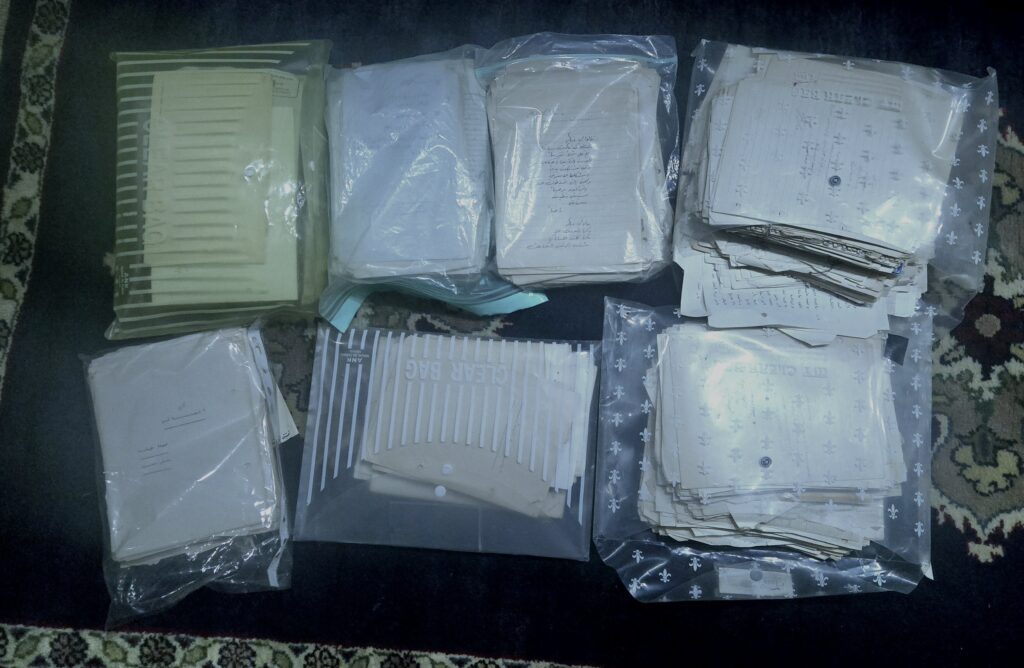
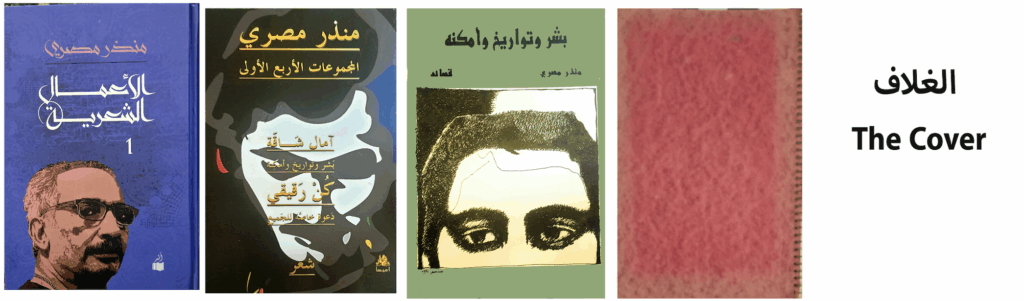
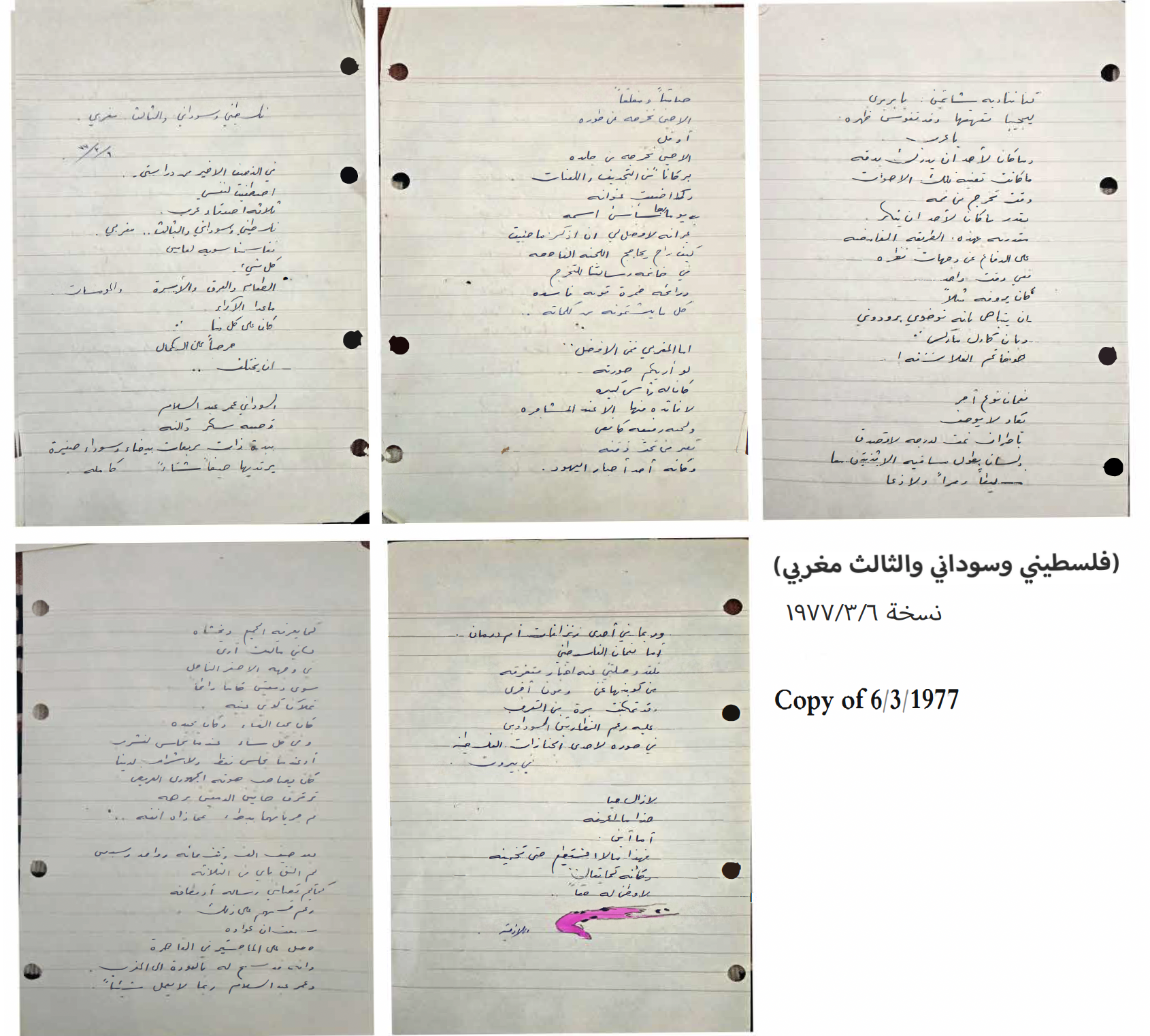
Yes, I don’t usually get rid of early versions of poems or book manuscripts. I keep them all, even now, in clear plastic envelopes, though they aren’t organized by date or by subject. The problem is that whenever I go back to them, which I do from time to time, I invariably add to the chaos—so much so that I despair of ever getting them in order. Which is why it took me a few hours to find the oldest version I still have of “A Palestinian, A Sudanese, and the third was a Moroccan,” dated June 3, 1977. That exactly matches the date of the manuscript—in the image below, it’s the notebook with the red cover—for Bashar wa tawarikh wa amkina (People, dates, and places), which was published by the Syrian Ministry of Culture at the end of 1979.
How did this poem start for you? Was it with an image, an idea, a phrase, or something else?
I wrote the poem around six years after graduating with a degree in Economics from Aleppo University and saying goodbye to those three friends, Nu‘man Kanafani, Omar Abd al-Salam, and Abdel al-Latif Awad. Six years without a letter or piece of news from any of them! This could be one reason I wrote the poem—to renew my memory of people whom I missed very much. But it was also the result of my feverish desire, at the time, to write poetry. That was a big part of it, my desire to write poetry that was very different from the kind of poetry, Syrian or Western, being written at the time. The title of poem indicates as much, as did the title of the collection. I remember the man in charge of selling books at Latakia’s Cultural Center said to me at the time that many people assumed my book had something to do with geography. Writing poems about friends was something I did a lot. In the book, there’s another poem that’s also about three friends of mine—“Muhammad, Ibrahim, and Mustafa”!
What were you listening to, reading, or watching while you were writing this?
I’m seventy-five years old and have always had music in my ears. I remember once listening to a song of Elvis Presley—I couldn’t have been more than sixteen—and one of my mother’s friends asking me if I understood anything he said. When I gave her the best translation I could manage, this woman, who was also a poet, turned to my mother and said, “Monzer is interested in words and meanings. I’m interested in melodies and music.”
I love all kinds of music—pop, folk, soul, blues, jazz. I could name a hundred musicians—American, British, Irish, Canadian—who are on my list of favorites. Bob Dylan, Leonard Cohen, Tom Waits, Tim Hardin, Peter Green, Cat Stevens, Carole King, and on and on. I learned so much from them. Same with the Beatles, the Rolling Stones, Cream, Led Zeppelin. That’s not counting all the jazz musicians and instrumentalists who give my life its soundtrack.
When I’m buried, I’d like them to put an MP3 player in the grave with me, hooked up to my headphones. Then I could listen to music while I’m dead, as long as the lithium battery keeps working!
How did writing the first draft feel to you? Did it come easily, or was it difficult to write? Are there hard and easy poems?
Long poems are definitely harder than short ones! Which doesn’t mean they’re better or more important—and certainly not more beautiful. I don’t remember that “A Palestinian, a Sudanese, and the third was a Moroccan”—a medium-length poem—was difficult to write, despite all the facts and ideas and feelings stuffed in it. That’s the kind of poem I like to write and to read, a poem that tells you about things and events, big or small, that really happened, then builds the significance of the poem on that basis. It’s like what T. S. Eliot says—the river is a strong brown god who deserves to be worshipped, even if it’s also, unfortunately, “a conveyer of commerce.” Or it’s like when Robert Frost asks the builder not to build his kitchen chimney on a shelf, since no house like that thrives.
How about the second draft? The third? How many drafts were there and what were the primary differences between them?
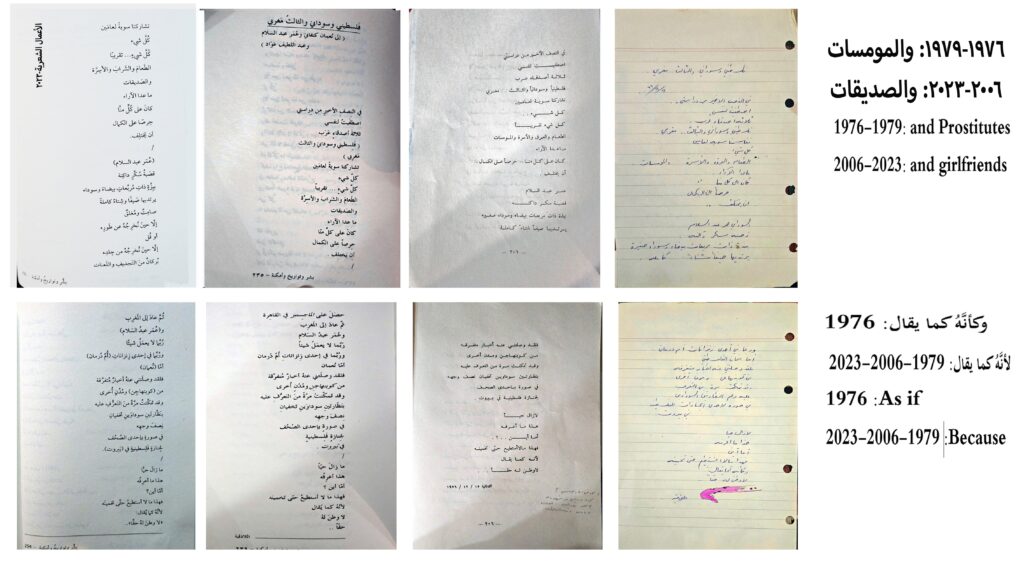
Yes, there are two words that differ between the first draft and the final version of the poem, the version published in three of my collections.
The first word, in Arabic, is al-mumisat—in English, “prostitutes,” or “ladies of the night.” That’s the word I used in the first draft of the poem, from June 3, 1977, which is also the word that appears in the manuscript and the first edition of the book itself. In two later collections, I changed the word to al-sadiqat—in English, you might say girlfriends—which seemed to me to have a more affectionate connotation. It was also a more accurate word, given the life we were living, than al-mumisat. Not that we didn’t have any of that sort of thing, but there was very little. Girlfriends were what the three of us shared—although that’s easier said than done! In retrospect, I’m a bit surprised the Ministry of Culture would publish a book whose author says he shared prostitutes with his pals. I think my friend and translator Robyn’s English choice, girls, slices through the knot very cleanly.
The second word, which comes in the second-to-last line of the poem, is ka’anna-hu (“as if as they say”), which is what appears in the first draft of the poem, then becomes li’anna-hu: “since as they say”). Since is the word I settled on for all the published versions. There’s obviously a big difference between as if and since, and now I prefer the first. Why should I want to be so cruel, so harsh? I would certainly insist that Palestinians today “have no homeland”! And yet I added the phrase as they say, as if I were distancing myself from that conclusion. Look at the note I wrote at the lower right corner on the last page of the poem, in its published version. There, I recorded in parentheses a phrase of the Palestinian poet Mahmoud Darwish, who said in the journal al-‘Arab, “We have no country and no exile.” He denies not only that the Palestinian has a country, but even that he has an exile! In citing this phrase, was I looking for evidence that would absolve me of what I say in the poem?
So you see how important one word can be, though a reader might easily skim over it.
Where did you write this poem? Can you share photos of your workspace, or workspaces?
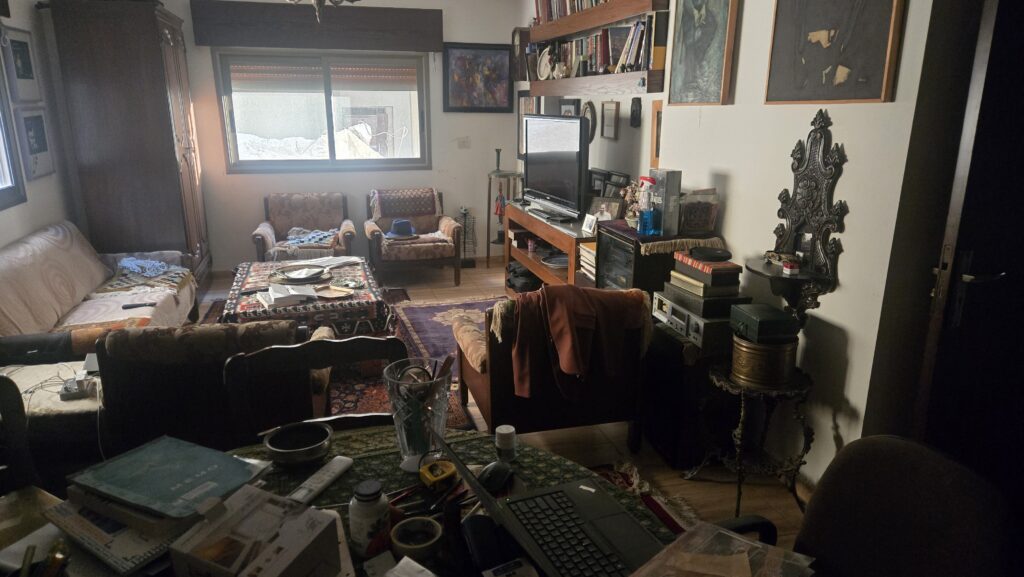
In 1976 I was living with my brother Maher in a single room in our family home. There were two beds with iron frames, a clothes chest with three drawers, and some bookshelves not yet filled with my books. There was also a sound system, for the records that we brought back with us from Beirut. I don’t think I have photos of that room. This is also when I began my work at the directorate of planning in Latakia, where I worked for thirty-five years, until reaching the age of retirement. Photos were less common in those days. But here is a photo of my current workspace.
How did you come up with the title for this poem?
As I’ve said, people didn’t find my early titles “poetic” in any familiar way. I was known as a poet whose titles were weird, not to say perverse. The title of one collection, Al-Shay laysa bati’an (Tea isn’t slow), is considered my weirdest. What does tea have to do with slowness or speed, people asked? I answer that question on the first page of my book. “Tea isn’t slow, it’s we who are fast.” As for the title of my latest collection—how’s this for a happy coincidence?—my publisher Riad El Rayyes just informed me today, while I was writing out these responses to these questions, that the title will be Yahsubuni al-dukhan nafidha (Smoke considers me a window). The original title, rejected by the publisher, was Nadam al-‘andalib (The nightingale’s regret). People will say, “The new title is prettier,” to which I say, “That’s the problem. I don’t want it to be pretty. I want it to be …” Actually, I don’t know what I want it to be. What I know is that I don’t want it to be poetic. The time has passed when my poetry was poetic—if in fact my poetry was ever poetic. My fate has always been to do something different.
What was the challenge of this particular poem?
To write a universal poem about particular people. To prove to yourself—and to everyone else—that you have within you a source or a river of poetry, which you want to bring forth to irrigate the earth, the trees, everyone.
Do you regret any revisions?
Absolutely not! As Leonard Cohen says, more or less, When they said ‘Regret, regret, regret,’ I didn’t know what they meant.
When did you know this poem was finished?
For me, a poem is done when there’s no way for me to write it better. There are so many possibilities—but then it’s up to you, with whatever sense of taste, abilities, and experience you have, to figure out what’s best. It does happen that I add entire stanzas to poems years after I’ve published them! In the case of “A Palestinian, a Sudanese, and the third was a Moroccan,” I do consider it a finished as a piece of writing, but unfinished in the sense that it can always be read again, and read differently. That will be true as long as someone else, anyone else, might come along and pick it up. Which does sometimes happen, and I hope will keep happening!
What I want to point out is that Robyn chose to translate a poem written fifty years ago by a distant and defenseless poet, a poet living in a country whose catastrophes have begun but not yet ended, and in a town known only to its inhabitants! That it should be published in The Paris Review, where so many great poets and writers have appeared, is a truly strange and also wonderful thing. I do cherish this poem and yet I didn’t include this poem in my selected volume, Li’anni lastu shakhsan akhir (Because I’m not someone else), nor do I typically recite it during my poetry readings in Syria or abroad—which have, admittedly, been very few, considering my advanced age and years of devoted service to the Association of Unknown Poets!
2. Robyn Creswell
How did translating the first draft feel to you? Did it come easily, or was it difficult? (Are there hard and easy translations?)
This is a question we don’t ask enough—what’s the distinctive feeling of working at translation? I don’t think hard and easy stake out the poles of possibility. My own feeling is some combination of readerly absorption, the pleasure (and frustration) of puzzle-solving, the excitement of making something new. With Monzer’s poem, there was also a social element to the experience. I hadn’t met Monzer before beginning this translation and my sense, while working, was that I was coming to know him somehow. I think that’s because of the sort of poem he writes—they’re very hospitable, and remind me of James Merrill in that way. Monzer’s poems take you by the hand and show you around his world. (Some of my favorites are a suite of lyrics called “Poems from my room.”) So my feelings while translating this poem were those of curiosity, attentiveness, surprise, and—when the puzzle pieces clicked together—the satisfaction of holding up my end of the conversation.
When did you know this translation was finished? Were you right about that? Is it finished after all?
In practical terms, when I can read a translation out loud to myself three times in a row without making any changes, it’s done. More generally, no translation is ever finished. There are definitive critical editions, there may even be definitive biographies, but there are no definitive translations. If I were to translate this poem again in five years and it came out the same way, that would only mean I’d learned nothing in the meantime.
Did you show your drafts to other writers or friends or confidantes? If so, what did they say?
I shared it with my friend and colleague Daniel Behar, who introduced me to Monzer’s work. Daniel has written the best book there is on modern Syrian poetry, and he has a great ear for what makes Monzer’s writing unique. I also showed it to Monzer, who made helpful suggestions without insisting on any of them—the ideal author for a translator!
In my initial version, the Moroccan friend is teasingly called a “Berber” by his pals. In Arabic, the word barbari is ambiguous between barbarian and the ethnic term Berber (the Arabic word is derived from the Greek barbaros). The force and playfulness of the insult is a little obscure in English—ethnic name-calling in one language never neatly matches up with that of another—but Monzer suggested Berberian, which I thought was brilliant.
What was the challenge of this particular translation?
What I so admire about Monzer’s poetry is its casual precision, the way his stanzas unfurl like complicated thoughts being improvised out loud. They’re full of small but significant qualifications—for instance, in the first stanza, “except our political opinions”—occasional backpedaling, surprising emphases, and even more surprising turns. The syntax of his sentences is marvelously flexible—the whole thing made of joints, yet seemingly smooth. Conveying that sinuosity in English, an uninflected language, is tricky. At first, I found myself making each line into a clause, which helped me keep track of how thoughts develop in the original. But it also meant that my lines felt stacked up, instead of freely flowing from one to the next. A lot of my revisions involved moving line breaks, making sure they weren’t too neatly cued up with the grammar. Removing punctuation marks also helped, for example in the sentence that begins, “As for Nu‘man.”
Do you regret any revisions?
Not yet.
Monzer Masri is a Syrian poet. His fourteen collections in the Arabic include Bashar wa tawarikh wa amkina (People, dates, and places).
Robyn Creswell’s most recent translation is Iman Mersal’s The Threshold. He is a professor of comparative literature at Yale.