Reading at Random with Virginia Woolf


Georg-Johann, random pixels, colored by Polyominoe, via Wikimedia Commons. Licensed under CC0 1.0.
“Let us try then to recapture some actual experience, which seems to have a connection with the experience of reading these old books; to spring from poetry; to be interfused with the same emotion,” Virginia Woolf writes in one of many fragmentary drafts of her final book, a history of English literature whose working titles included “Reading at Random.” It was to be nothing less than her own philosophy of reading. More than mere absorption of the written word, reading, for Woolf, was an active expression of the mind and a mode of “actual experience.”
At the time of her death in March 1941, Woolf had begun work on only two chapters of the book, titled “Anon” and “The Reader.” The New York Public Library’s Berg Collection holds the full archive of “Reading at Random,” including multiple manuscript and typescript drafts of each chapter, as well as Woolf’s initial reading notes. The project is little-known and hardly legible, composed as it is of disintegrating notebooks and unbound pages, the letters jumbled, the margins mottled with penciled and penned notes, the versos soiled, the edges crinkled, the handwriting spidery. To make any sense of the matter, the reader must squint her eyes and relax her mind and allow the words to occasionally, here and there, flower into meaning.
“Reading at Random” begins with a voice. It is the voice of Anon, the anonymous bard at the back door of the aristocratic great house, whom Woolf imagines as the origin point of the English literary project. While the phrase literary history suggests a straightforward chronology, Woolf suggests that its beginnings were disorganized, deviant; Anon’s was “a voice that stumbles, that repeats, that loses the thread of its argument …” It was also a voice that sometimes included a broader audience, or riffed on one. “He was a simple singer,” Woolf writes of Anon, “lifting a song or a story from other people’s lips, and letting the audience join in the chorus.”
Across the text’s two extant chapters, Woolf traces the development of English literature through the lens of its consumers. At first an itinerant singer living on the fringes of society, Anon gains renown with the advent of the Elizabethan playhouse and its raucous audience, followed by the growing primacy of the printing press, which in turn births the single, solitary figure of the reader. This is the story of a collective experience whittled down to an individual consciousness—her own. Woolf’s underlying quest is to discover how we can again connect reading to the book’s primeval, communal, and experiential origins: how to travel “the roads now faded in the mind,” uncover “the source of the sunk impulse … the hidden spring, the gush of water deep beneath the mud,” tunnel our way back to what she calls “the song beneath” the book.
***
On October 17, 1940, Woolf recorded her new book idea in her diary, describing her plan to “transfer my habitual note taking I think—what I do on odd days—to random reading.” A methodology of disorder was at the heart of this project. “Random”-ness comes to stand in for an entire state of mind, the space of imagination that exists between reader and book. “Read very widely,” she instructs herself in an outline, but “write rather from memory.” In the book’s second chapter, “The Reader,” she observes that “it is equally important, to the understanding of the poem, not to read at all.” Why? What is the power of this empty space, this absence of mind, this not-reading that reading provokes in us?
For Woolf, what a reader attains by not reading is “that state of mind in which it seems possible to us to write the book, not to read it.” This unexpected porousness between reader and writer is our inheritance from the literary traditions of the premodern world, for “it is still the anonymous voice speaking anonymously generally that the listener already half knows, or half remembers. The listener hears the voice partly in himself,” as Woolf writes in a typescript fragment of “Anon.” Not-reading reproduces in the reader the collaborative effect that anonymous authorship once had on an audience, or on a listener.
“Half knows, or half remembers.” Foreknowledge and memory: an intuitive recognition that reaches in both directions at once, toward the future and toward the past. There is a ghostly quality to this always-already state of the relationship between reader and writer. In A Room of One’s Own, Woolf speculates:
Nature, in her most irrational mood, has traced in invisible ink on the walls of the mind a premonition which these great artists confirm; a sketch which only needs to be held to the fire of genius to become visible. When one so exposes it and sees it come to life one exclaims in rapture, But this is what I have always felt and known and desired! And one boils over with excitement, and, shutting the book …
Rapture, for Woolf, is recognition. Recognition relies on something that already exists, and this is Woolf’s ideal of writing: it calls forth what already exists, but is not yet known, in the reader. You might call this a kind of emotional knowledge; you might call it the unconscious, a submerged level of sense that the conscious mind can register only as “random”-ness. It is worth noting here that Woolf’s Hogarth Press was Freud’s publisher in English, and she was reading his work around the time she drafted “Reading at Random.” One penciled margin note on a typescript passage of “Anon” conjures Woolf’s idea of reading as a recognitive process: “It brought to the surface the old hidden world.”
In To the Lighthouse (1927), Mr. and Mrs. Ramsay sit together reading in the library after dinner. Each longs to communicate with the other, but neither can find the right words. Taking up a volume of poems, Mrs. Ramsay “began reading here and there at random.” The words resonate and echo in her mind, seamlessly interweaving with her thoughts, lulling her “like a person in a light sleep.” The book, though Woolf does not say so outright, is a collection of Shakespeare’s sonnets; and it can be no coincidence that Shakespeare, for Woolf, is the quintessence of anonymity in writing. In her “Reading at Random” notes, she writes, “About Shre: the person is consumed: Sre never breaks the envelope. We dont want to know about him: Completely expressed. When the incantation ceases, we see the person.” Who is “the person,” exactly—Shakespeare or his reader? For as long as the incantation lasts, both are “consumed” together.
When the Ramsays lay their books aside and begin, finally, to talk, the quality of their togetherness has changed. Though Mr. Ramsay is still “thinking of Scott’s novels and Balzac’s novels,” Woolf writes, they are now “drawing together, involuntarily,” and Mrs. Ramsay can “feel his mind like a raised hand shadowing her mind.” Mr. Ramsay badly wants his wife to tell him that she loves him, but Mrs. Ramsay confronts a check, an insurmountable obstacle, for “she never could say what she felt.” But as the scene ends, they are looking at each other and Mrs. Ramsay is smiling. She has not said that she loves Mr. Ramsay. And yet in her mind “she had triumphed again. She had not said it: yet he knew.”
Mrs. Ramsay’s triumph, and Virginia Woolf’s ideal, is communication without need of language. This would seem, on the face of things, to be precisely the opposite of reading or writing; and yet the moment of silent communion is enabled only by the long scene of reading that precedes it, just as reading is a precursor to that moment of recognition, that state of mind in which one can shut the book, having absorbed its voice as though it were one’s own. The reader-writer relationship models this possibility of shared consciousness.
***
In her unfinished memoir “A Sketch of the Past,” written contemporaneously with “Reading at Random,” Woolf describes a formative moment from childhood in which for the first time she understood a poem she was reading. “I had a feeling of transparency in words when they cease to be words and become so intensified that one seems to experience them; to foretell them as if they had developed what one is already feeling,” she writes. Whereas the fictional Ramsays connect with each other through this very sensation, when the young Woolf of “A Sketch” tries to explain her feeling about the poem to her sister, Vanessa Bell, she fails to make herself clear. “I suppose Nessa has forgotten; no one could have understood from what I said the queer feeling I had in the hot grass, that poetry was coming true.” The sensation must remain Woolf’s own, and yet not her own, for it is shared—if not with Vanessa, then with the (anonymous) poet, and now also with Woolf’s own reader. We understand her exactly, for this “queer feeling” has been felt by readers always (Emily Dickinson: “If I read a book and it makes my whole body so cold no fire can warm me I know that is poetry. If I feel physically as if the top of my head were taken off, I know that is poetry. These are the only ways I know it. Is there any other way?”).
James Wood wrote that Woolf’s “greatest fiction is moved by the faith that to have visions is to see beyond aesthetic vision.” It’s a cunning take on the last line of To the Lighthouse, in which Lily Briscoe completes her post-Impressionist portrait of Mrs. Ramsay (“Yes, she thought … I have had my vision”). Wood implies that the novel itself, like Lily’s painting, is but a transitional object to reach for some greater truth. Though Woolf was a fervent atheist, her drafts for “Reading at Random” do theorize the English literary tradition as a quasidivine medium—an intercessor of sorts—between alienated modern man and what she likes to call reality. “If I could catch the feeling, I would,” Woolf wrote in a 1929 diary entry cited by Wood; “the feeling of the singing of the real world, as one is driven by loneliness and silence from the habitable world.” The true language of reality is not writing, for writing is but a fragmentary grasping, a failed attempt to “catch the feeling.” It is singing. The “old hidden world” of Anon is a historicized version of Woolf’s longed-for “real world,” in which thought and expression are continuous, and life and literature are one.
There is a photograph I love of Virginia Woolf’s parents in the library at Talland House, the family’s beloved summer home in Cornwall. On a small sofa, which is angled away from the camera, Leslie and Julia Stephen sit pressed against each other, reading. Though they are reading separate books, they seem somehow unified in their closeness and their attention, so absorbed as to appear unaware of whoever the photographer might have been. One cannot help but think of Mr. and Mrs. Ramsay with his Scott and her Shakespeare. But here there is a difference, an additional presence: Virginia herself as a young girl, sitting behind the sofa, half-obscured by her father’s figure. Only her head is visible, cutting straight across her parents’ diagonal line. She is looking right at us, her chin propped in her hand. The photograph gives the viewer the sense of occupying two scenes at once: the moment of intimacy between the Stephens, and that moment as it is captured by the young Woolf’s gaze. Her not-reading gives their reading meaning—though, of course, I am projecting the future onto the past. She is only eleven; she has not yet written a masterpiece. All the same, one feels that the novel is there in her eyes already. She is making poetry come true.
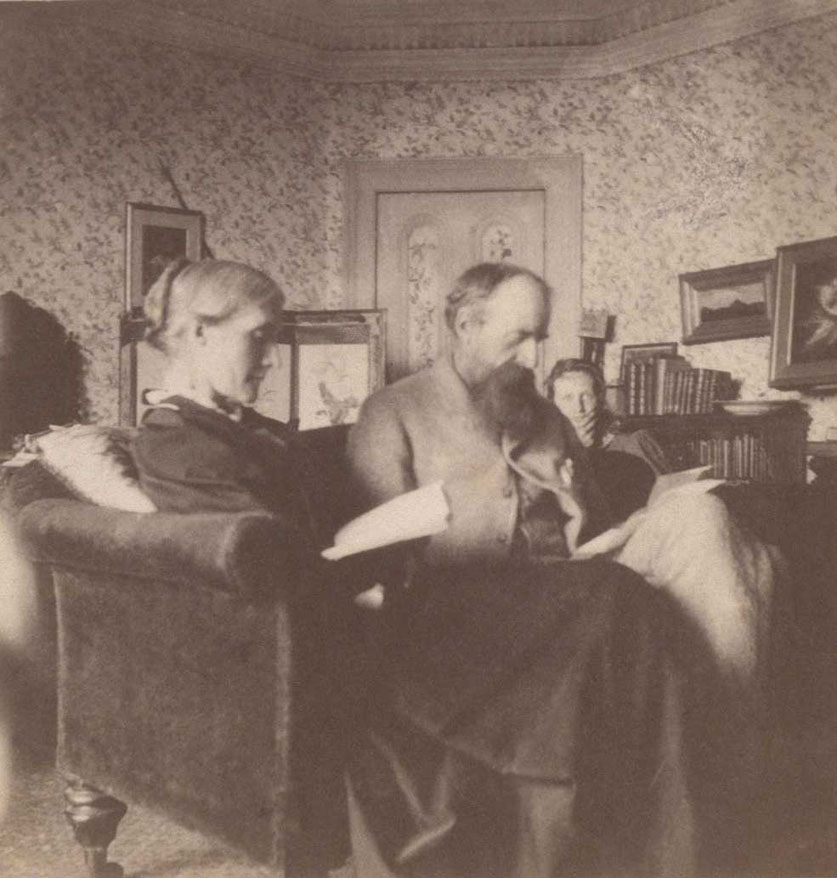
Virginia Woolf’s parents, Julia and Leslie Stephen. From the Leslie Stephen photograph album in the Mortimer Rare Book Collection at Smith College Library, Special Collections.
Frances Lindemann is a writer and educator. Her work has appeared in The Drift and The Times Literary Supplement.
Copyright
© The Paris Review

