How One Man Helped Make America a Global Tax Haven

During the mid-1990s, trust and estate lawyer Jonathan Blattmachr had an innovative idea that would come to revolutionize the American trust industry. Blattmachr is a veteran of the wealth management field, cutting his teeth at the famous white shoe law firm Milbank, Tweed, Hadley & McCloy, wealth managers to the Rockefellers and other dynastically wealthy families.

Then based in New York, he knew about the success of offshore jurisdictions—places like the Cayman Islands and the Cook Islands allowed super-rich Americans to secretly stash their wealth overseas, hidden from creditors and the tax man. But many of his clients, he believed, would not “want to have their assets in a place they couldn’t find on a map.”

What if, Blattmachr thought, the offshore came onshore?

When Blattmachr proposed that New York allow onshore asset-protection trusts, “people thought I was absolutely out of my mind.” So he took his idea to Alaska instead.

With traditional trusts, you have the grantor (a.k.a. the client) who creates the trust and puts it in the care of a third-party trustee for the benefit of his beneficiaries—usually the grantor’s spouse or children. When offshore banking centers were first emerging, a major attraction was that they allowed grantors to create what’s known as an “asset protection” or “self-settled spendthrift” trust and house it offshore. Such trusts can be established for a very specific beneficiary: the grantor himself. (Most grantors are male.) By claiming he no longer owns the assets—in a way, they belong to the trust—he is able to avoid wealth-transfer taxes such as the estate tax, and dodge creditors, too. The intention is to put the grantor’s assets in an “ownership limbo,” which obfuscates his legal responsibilities. 

That’s what was going down offshore in the 1980s and 1990s. Blattmachr was riveted by the question: What if the United States hosted these trusts, too? You could have domestic asset protection trusts. He brought his idea to the trusts and estates law section of the New York State Bar Association, and was “unanimously shot down,” as Blattmachr told the trade publication Tax Notes in 2016. “People thought I was absolutely out of my mind.” See, some lawyers deemed the purpose of an asset protection trust—allowing people to insulate their money from creditors—a form of fraud.

Continue reading

Copyright

© Mother Jones

0
  300 Hits

11 films to watch this October

11 films to watch this October

A biopic of Emily Brontë and a romcom starring George Clooney and Julia Roberts

Copyright

© Mother Jones

0
Tags:
  280 Hits

“No One Needs to Be Reminded of the Sanctity of Life”

Thursday’s House Oversight Committee hearing on abortion bans was a predictable, three-hour medley of left- and right-wing talking points. Republicans accused Democrats of wanting abortion policies in line with those of North Korea and China; Democrats accused Republicans of promoting repressive policies that are comparable to how the Saudi and Iranian regimes treat women. The “fentanyl candy” hysteria made an appearance, as did an out-of-context Shakespeare quote about demanding a pound of flesh.

But one witness cut through the noise, rejecting the “binary yes or no” approach to discussing abortion and shedding light on the humanity of the people who choose to terminate their pregnancies. Kelsey Leigh, a Pittsburgh woman who now works at a reproductive health center, said that she was 20 weeks and six days into a desired pregnancy when she learned that her child had a severe fetal anomaly that she considered “not compatible with life.” At 22 weeks, she had an abortion. “I could not carry my son for four more months to give birth to him knowing that his life would only be filled with pain and suffering,” she said.

During the hearing, Rep. Clay Higgins (R-La.) shared his own story of losing a child to justify his position that “I support life, from conception to natural death.” Higgins said that his daughter Daniela died after being born three months prematurely, but that her short life was still valuable. “Our daughter Daniela breathed life into us,” he said. “She touched every life that she gazed upon.”

Leigh responded that the two stories are not incompatible. “No one needs to be reminded of the sanctity of life,” she said. “We need to be reminded that this is a nuanced, complex decision that is never gonna be answered by a binary yes or no question or the amount of weeks that my ultrasound shows. We need to leave people alone to make these decisions for themselves and their families and the betterment of their communities.”

Asked by Rep. Rashida Tlaib (D-Mich.) why abortion bans are dangerous for families like hers, Leigh had some harsh words for the representatives who used their time to describe the stages of fetal development. “It’s demeaning and it’s insulting to insinuate that that’s what I need to hear to know that my son, and that his life, mattered,” she said. “The rhetoric and the sensationalization create stigma and shame, and it’s wrong. And it’s really difficult to sit here and to hear that, and then not actually be looked in the eye and be asked about my experience.”

Continue reading

Copyright

© Mother Jones

0
  324 Hits

Fairy Tale

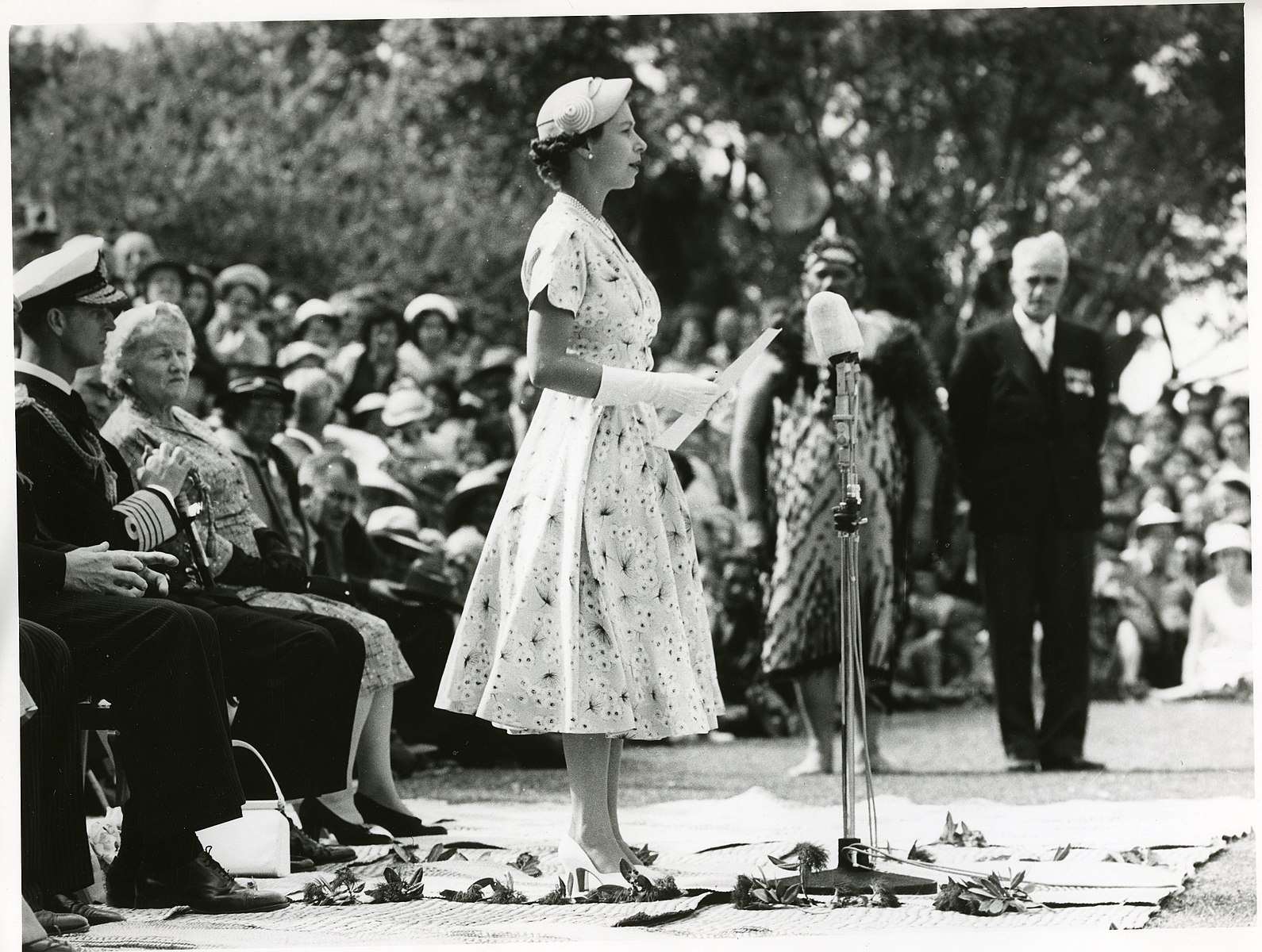
“My mother couldn’t believe the Queen’s hats. My mother disliked birds and hats.” Queen Elizabeth II in New Zealand, 1953. Licensed under CC0 2.0.

When the Queen of Tuvalu died, I remembered.

My parents were pleased that at ten years old I liked Mark Twain. And then they discovered that, as with Cleo the Talking Dog five years earlier, I would not move on from The Prince and the Pauper. I wasn’t interested in any other non-school book. I’d seen the film of Twain’s novel and Errol Flynn had the right to sit in my presence every week when I reread my favorite parts. Tom Sawyer? Any luckily orphaned boy princes? No? Then no thanks.

My mother had purchased from a door-to-door salesman in 1958 our 1957 edition of The World Book Encyclopedia. We never owned another set. My knowledge of the world came from our ever more out-of-date encyclopedia. My science is still very Sputnik-era. I let the twenty-four taped, dogged volumes go with much regret in 2009 after my parents died. As I was tiring of Twain’s lookalike boys and their protector, Miles Hendon, I found in the encyclopedia a black-and-white illustration of a painting of two princes in dark clothes. They had light long hair and looked scared. Princes were unlucky. I lived in Indianapolis, Indiana. I longed to be unlucky. The two brothers were in a place with a dark staircase called the Tower of London. And, yes, the L volume of our encyclopedia set had so much on London, headed by a drawing of really old London dominated by “S. Pauwls Church.” I studied the narrow houses packed around it. My father couldn’t tell me for sure what “eel ships” were, but they were the largest vessels on the river in the drawing. So that’s where my nursery rhyme jumble of “all fall down” came from.

(When did I come across the drawing that had the Globe Theatre marked in it and London Bridge full of houses over the “Thames fluuius”? Much later, when Shakespeare’s history plays were still way over my head.)

Continue reading

Copyright

© Mother Jones

0
  333 Hits

On The Continent: Less Ronaldo, More Portugal?

Dotun, Andy and David Cartlidge are here with a state of play after the final international break before the World Cup. We wonder if Germany might prove entertaining rather than efficient come Qatar and whether the problems plaguing France have knocked them off their prime perch. 


There’s also time for a Barcelona injury update and a question even devoted fans are starting to ask: do Portugal need to move on from Cristiano Ronaldo?


Got a question? Tweet us @FootballRamble and email us here: This email address is being protected from spambots. You need JavaScript enabled to view it..


Sign up for our Patreon for exclusive live events, ad-free Rambles, full video episodes and loads more: patreon.com/footballramble.


***Please take the time to rate and review us on Apple Podcasts or wherever you get your pods. It means a great deal to the show and will make it easier for other potential listeners to find us. Thanks!***

Continue reading

Copyright

© Mother Jones

0
Tags:
  287 Hits

California Leaders Want to Compensate Descendants of Slavery. How Much Are They Willing to Pay?

This past weekend, activists, economists, politicians, and members of the public packed a room at the California Science Center in Los Angeles to talk about reparations. Members of the California Reparations Task Force, a first-of-its-kind group, gathered for their tenth meeting to grapple with some of the difficult questions they have yet to answer about what California owes to descendants of slavery.

At the top of everyone’s mind was how to begin to calculate the amount the state should owe for the harms it has committed. The Task Force has to decide how much California should owe eligible Black residents not just for its involvement in slavery, but also for all the lingering trauma that has followed and the impacts it has had on every facet of society.

Though California’s 1849 state constitution was meant to be anti-slavery, the state was complicit in upholding the institution. There are no exact counts, but one Gold-Rush-era source estimates that in 1852, there were 1,500 enslaved African Americans living in in the state. The same year, California passed a state fugitive slave law, which not only criminalized formerly enslaved people who had escaped to the state from across state lines, but also people who had escaped there before California had even officially become a state. 

To study these harms and try to understand how they could possibly be remedied, the Reparations Task Force was created in September 2020, with the passing of AB 3121. The Task Force has two main objectives: 1) To “study the institution of slavery and its lingering negative effects on living African Americans…and on society”; and 2) to make recommendations for “compensation, rehabilitation, and restitution for African Americans.” In other words, it’s time for the government to pay up.

The Task Force issued its first report in June, with a final report due by July 2023. The interim report includes preliminary recommendations, ranging from a proposal to repeal policies that contribute to housing segregation to calls for free healthcare programs and the elimination of discriminatory policing. The interim report also recommends that the state should implement a reparations program to address its racial wealth gap (which one 2016 estimate put at around $350,000 in Los Angeles), though the Task Force has yet to decide the size of that payment.

Continue reading

Copyright

© Mother Jones

0
  338 Hits

Why a 1922 horror film still terrifies

Why a 1922 horror film still terrifies

The chilling power of controversial documentary-horror Häxan, 100 years on

Copyright

© Mother Jones

0
Tags:
  266 Hits

An Iranian Journalist Who Reported on Mahsa Amini’s Death Is Now in Solitary Confinement

An Iranian journalist who reported on the death of Mahsa Amini has been thrown into solitary confinement, with no information about the charges against her, amid a major crackdown on the press in the country.

Niloufar Hamedi, a reporter at the Tehran-based Shargh newspaper, was among the first to write about Amini, 22, who fell into a coma and died on September 16 after Iran’s morality police apprehended her and brought her to a “re-education” center for not wearing her hijab properly. Authorities say Amini died after a heart attack, but her family says she had no prior health problems and accuse the police of beating her.

“When we shouted and protested inside the room, they started threatening us that if we didn’t keep quiet, they would rape us.”

The 22-year-old’s death ignited massive protests across Iran, organized primarily by women, whose rights have been heavily restricted since the 1979 Islamic Revolution. Her name has also gained global recognition, with world leaders condemning her death and the subsequent violence toward protesters. “We call on the Iranian authorities to hold an independent, impartial, and prompt investigation,” experts appointed by the UN Human Rights Council said in a statement last week.

Hamedi took a photograph that went viral of Amini’s grief-stricken parents hugging in the hospital, according to the news site IranWire, which wrote about the reporter’s incarceration on Monday. At least 18 journalists have been arrested in Iran since the demonstrations began, according to the nonprofit Committee to Protect Journalists. Press freedom groups have called for their immediate release. “They were doing their jobs,” the Association of Iranian Journalists said in a statement. The country has also experienced a near internet shutdown and disruptions to phone and social media networks that have made it more difficult to share news. “[T]he Iranian authorities are sending a clear message that there must be no coverage of the protests,” the Middle East desk of Reporters Without Borders, another nonprofit, said in a statement. “We demand the immediate release of these journalists and the immediate lifting of all restrictions on Iranians’ right to be informed.”  

The protests in Iran began with demands to end the mandatory hijab laws that likely led to Amini’s death, but the demonstrations have grown to more broadly oppose Iran’s leaders and clerical establishment. Thousands of people in dozens of cities have taken to the streets, with Kurdistan as the epicenter of dissent: Amini was Kurdish, part of a Sunni Muslim ethnic group that has long suffered under Iran’s Shiite government and has waged a separatist movement for decades.

Continue reading

Copyright

© Mother Jones

0
  370 Hits

Deep Emotion, Plain Speech: Camus’s The Plague

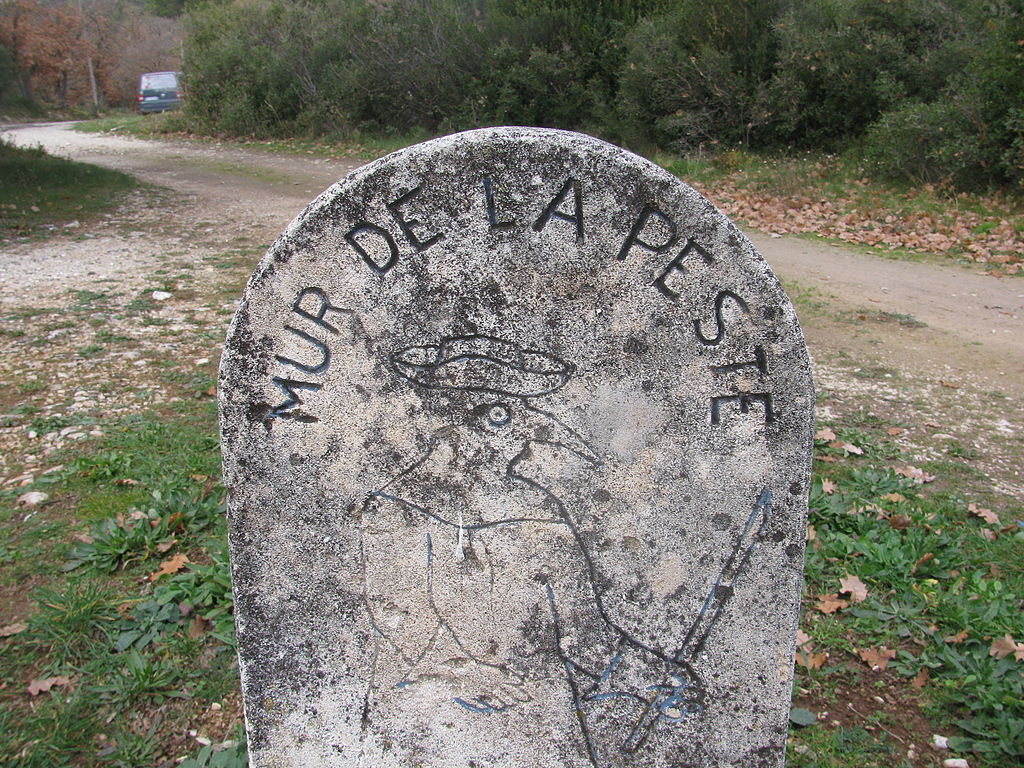
Mur de la Peste, Lagnes. Photograph by Marianne Casamance, CC BY-SA 4.0, via Wikimedia Commons.

The Plague was not an easy book to write. Camus was ill when he began it, then trapped by the borders keeping him in Nazi-occupied France. Aside from these difficulties, there was the pressure of authentically speaking up about the violence of World War II without falling into the nationalist heroics he deplored. Like with most problems in art, the solution was to address it directly: in one of the most revelatory sections of the novel, the character Tarrou blurs the line between fancy rhetoric and violence. “I’ve heard so much reasoning that almost turned my head,” he says, “and which had turned enough other heads to make them consent to killing, and I understood that all human sorrow came from not keeping language clear.”

All human sorrow! The boldness of this claim hints at how much Camus believed in words. The Plague is full of people who struggle to clarify their language and strain to make it more precise: Grand, Rambert, Paneloux, and even Rieux all try—and often fail—to express their deepest feelings through words. But in writing, Camus manages to develop a style that encapsulates feeling within the sentence structures themselves—a kind of syntax that captures deep emotion in plain speech.

For example, the first time Rambert tries to get out of the city, the smugglers who might help him escape don’t show up, and he despairs at the thought of having to retrace his steps:

At that moment, in the night spanned by fugitive ambulances, he realized, as he would come to tell Doctor Rieux, that this whole time he had somehow forgotten his wife by putting all his energies into searching for a gap in the walls that separated him from her.

Continue reading

Copyright

© Mother Jones

0
  347 Hits

Boris Johnson drama is 'too soon'

Boris Johnson drama is 'too soon'

The 'fiction based on real events' is flawed

Copyright

© Mother Jones

0
Tags:
  262 Hits