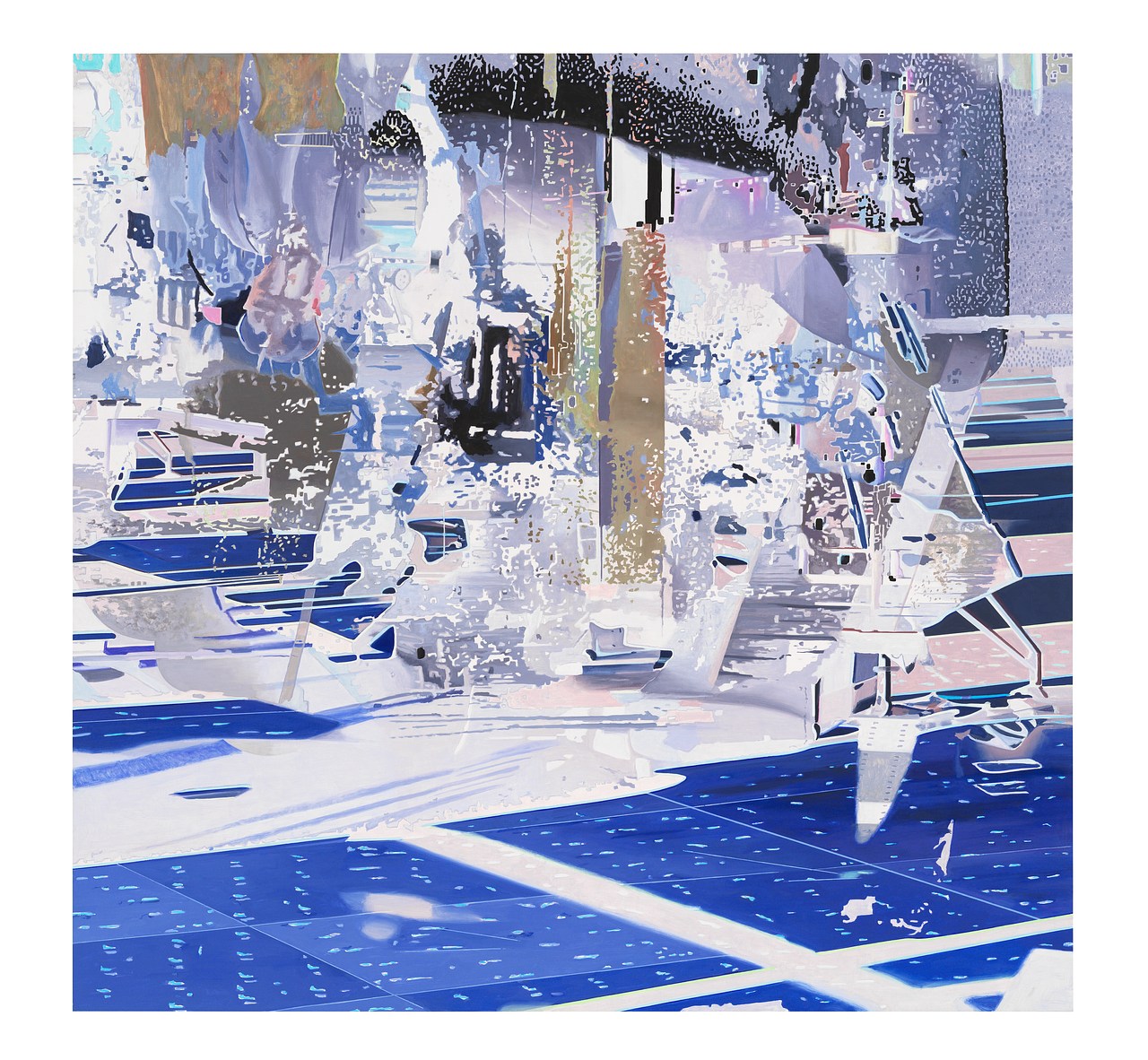
October 8 – November 12, 2022
Copyright
© Contemporary Art Daily

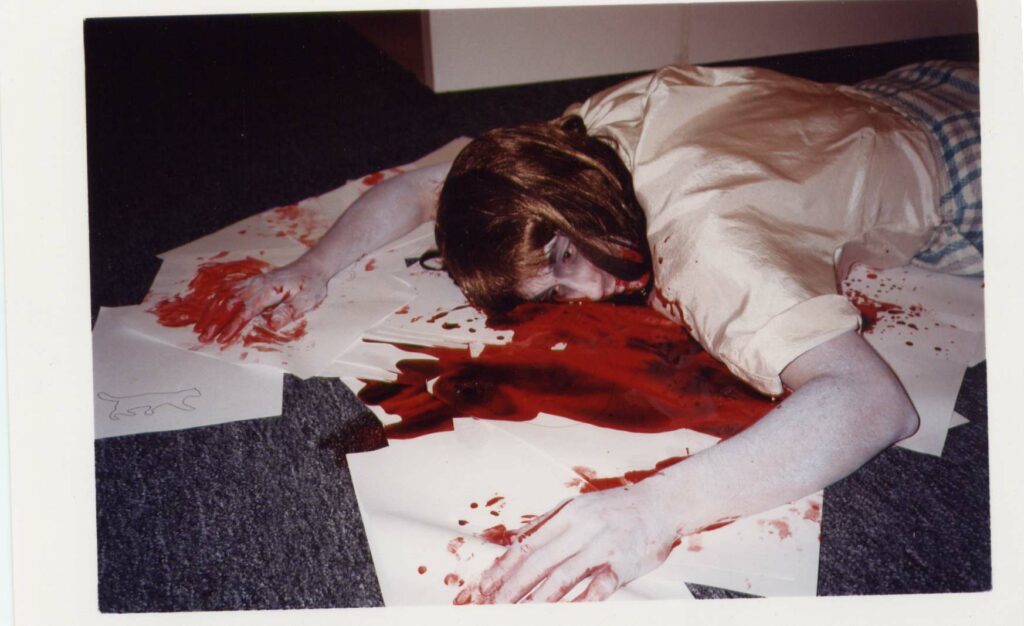
DAWN KASPER, “MICHELLE FRANCO” (2003), ANNA HELWING GALLERY, CHICAGO ART FAIR. Photo courtesy of David Lewis Gallery.
Around the turn of the millennium, when she was twenty-three, the artist Dawn Kasper began picturing herself dead. Then a first-year graduate student at UCLA Arts, she was spending a great deal of time in isolation in her studio, and the rest of her time consuming material that revolved in some way around violence: video nasties, death-scene photographs by Weegee, Andy Warhol’s Death and Disaster silk screens, etc. Eventually, a nagging thought set in: However many entries she slotted into her ever-expanding mental Rolodex of female death scenes—Janet Leigh bleeding out in a motel bathtub, or Sherilyn Fenn having her pretty head cracked open in a car crash; Teri McMinn’s slender shoulders being sickeningly thumped onto a meat hook, or the sister in Catherine Breillat’s Fat Girl being slashed through with an axe—she would never have the opportunity to see her own death as a cinematic image. “I wanted to see what I looked like dead,” Kasper recalls in an email. “I began to feel afraid—not of my own mortality, but of never knowing how I might die.” It is not unusual for a first-year student, and a first-year art school student in particular, to be morbid. What was unusual about Kasper’s burgeoning obsession with death was her conviction that it might be possible to influence the circumstances of her own demise. She began to believe that if she could fake being killed in every possible scenario, she could cheat fate, as if anticipating all of death’s potential moves might neutralize them. “As a woman, I felt so out of control,” Kasper says of herself at that age. “I began to worry that I was crazy.”
I first heard about Dawn Kasper’s series Death Scenes via a fleeting mention on a podcast by the brilliant Irish critic Sean McTiernan. Curiously, I could find little in the way of documentation of the work online, save for a brief summary of the project on the artist’s Wikipedia page under the heading “Early work”: “For this series Kasper assumed a performative rigor mortis with a mise-en-scène reminiscent of B horror films and Weegee-eqsue crime scene photography.” The entry quotes art critic Rachel Mason: “For years, Dawn could be spotted, dead, at art events all over Los Angeles, in the tradition of Harold and Maude, sprawled out in an elaborate shrine to some horrific accident.” Kasper researched real accidents both as a means to ensure the visual and physical accuracy of her performances, and to exorcise her terror more completely. “I didn’t care so much about the audience,” she admits. “I wanted to feel; I wanted help. I guess looking back I was very selfish, because I just dumped all over them, and didn’t even look back or ask questions.”
Dawn Kasper, “The Motorcycle Accident” (2003), Anna Helwing Gallery. Photo courtesy of David Lewis Gallery.
If self-injury is in some way the ultimate use of the body as material, a rejection of personal safety and good sense in service of a higher and more significant goal, the act of dying (or “dying”) in public might be the most perfect and most crystalline expression of that impulse. Other artists have come close. The famous poet and performer Bob Flanagan—who suffered from cystic fibrosis, and who claimed that his passionate love of S&M was what allowed him to outlive his terminal prognosis by two decades—gestured to his imminent death again and again in his work, with coffins and obituaries and hospital beds recurring as motifs. In his ideal artwork, he informs the audience in the 1997 documentary Sick, “I’d be buried with a video camera … in a tomb,” with a connection from the camera to a video monitor. The piece would be called The Viewing, “and every so often someone [could] walk into the room and turn on a switch, and see how I’m progressing.” Doctors had told Flanagan that he would die at twenty-five, right around the age Dawn Kasper was when she first became obsessed with recreating her own hypothetical expiry. If her youthful mania was about prevention, Flanagan’s felt more like goading, a seduction. “I keep thinking I’m dying, I’m dying,” he wrote in his diaristic book of sickness, The Pain Journal. “But I’m not, I’m not—not yet.” Both artists have channeled a sense of terrible helplessness into a form of personal and creative empowerment, the results provocative precisely because they beckon something we are naturally inclined to avoid.
© Contemporary Art Daily

The wheels are officially falling off at Liverpool as Jesse G’s Leeds #playliketheworldiswatching. But what’s going on at Anfield!?
Marcus, Jim and Vish are joined by OTC’s finest, David Cartlidge! They discuss two big old upsets as Graham Potter is left seeking Thomas Tuchel’s Indian health retreat, while Mount Vesuvius in Tottenham remains dormant for now. We do hear about one Italian manager who injured an opposition coach with a focaccia, though. Obviously.
Plus, an unlikely standoff between Marcus and Pat Nevin.
Vote for us in this year's FSA Awards here!
Tune in to our Marseille vs Spurs Twitch watchalong and live Ramble Reacts on Tuesday night here!
© Contemporary Art Daily

From Living to Breaking Bad: Film and TV that helps us process the inevitable
© Contemporary Art Daily
Here's a little taste of what we've been up to this month...
We'll be here with daily episodes throughout the World Cup! So hit that subscribe button and get new episodes of the Football Ramble delivered every weekday!
Hosted on Acast. See acast.com/privacy for more information.
© Contemporary Art Daily

David DePape, the man accused of bludgeoning the husband of House Speaker Nancy Pelosi early Friday morning apparently posted a lot of politically extreme things online and apparently subscribed to a lot of conspiracy theories. Among them: QAnon. According to the Associated Press, DePape wrote blog posts as recently as August 24 promoting the far-right theory:
An Aug. 24 entry titled “Q,” displayed a scatological collection of memes that included photos of the deceased sex offender Jeffrey Epstein and made reference to QAnon, the baseless pro-Trump conspiracy theory that espouses the belief that the country is run by a deep state cabal of child sex traffickers, satanic pedophiles and baby-eating cannibals.
“Big Brother has deemed doing your own research as a thought crime,” read a post that appeared to blend references to QAnon with George Orwell’s dystopian novel “1984.”
The suspect’s exact motivation has yet to be established. But this week’s attack on Pelosi’s husband isn’t the first time an apparent QAnon follower has allegedly targeted the House Speaker with violence. On January 7, 2021, the FBI arrested Cleveland Grover Meredith at a DC hotel after he texted friends that he was, “Thinking about heading over to Pelosi’s… speech and putting a bullet in her noggin on live TV.” Meredith had been planning to be at the Capitol on January 6 but had car trouble and never made it. The FBI found hundreds of rounds of ammo, guns, and an assault rifle in his trailer. In 2018, Meredith put up a billboard emblazoned “#QANON” that advertised his car wash in Georgia. When the Atlanta Journal-Constitution asked him about it, he said he’d been drawn to QAnon by “common sense.” In court, his lawyer said that Meredith had “found a sense of purpose” in the QAnon world. He was sentenced to 28 months in prison.
QAnon emerged in 2017 as an online phenomenon, with followers taking cues from the anonymous “Q” who posted cryptic messages on 8chan. But it has been bleeding into real life in a violent fashion. In 2018, for instance, a man drove an armored truck to the Hoover Dam claiming to be on a mission from QAnon to force the Office of the Inspector General to release the “real” report on Hillary Clinton’s missing emails, referring to another strand of the far-right conspiracy theory. He engaged in a standoff with police before finally being arrested.
© Contemporary Art Daily
Alan Hutton has supported Arsenal’s pursuit of Leandro Trossard as they look to add the Belgian to their squad.
The Brighton star has been in fine form this season and continues to show why he deserves to play for a bigger club soon enough.
Trossard has interest from several clubs around the World, but Arsenal wants to win the race for his signature.
However, will he fit into their style of play? Former Aston Villa man Hutton believes so. He tells Football Insider:
“I think he is definitely that type of profile that Arsenal look at. He likes to drive forward with the ball, can make things happen, score a goal. He can probably play multiple positions.
© Contemporary Art Daily
Arsenal is one of the most improved clubs in Europe this season, thanks to the performance of some of their players.
The Gunners have spent the majority of the term at the top of the league table and could remain there for long if they stay in form.
Two men driving their success this season are Gabriel Martinelli and Granit Xhaka.
The Daily Mail released the list of the most improved players in the EPL this season and they featured on it.
On Xhaka, they wrote:
© Contemporary Art Daily
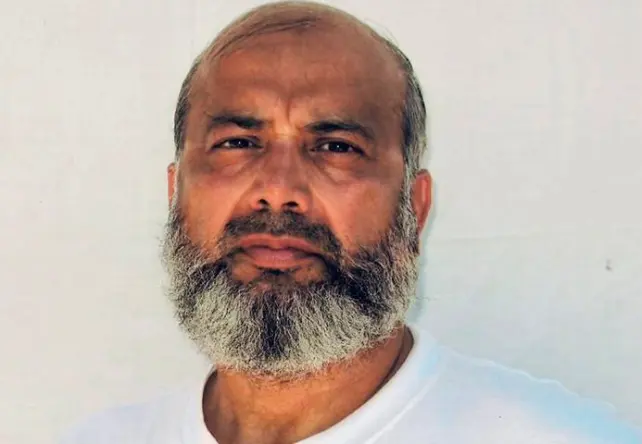
The Guantanamo Bay detention center isn’t anyone’s idea of an assisted living facility. But the controversial prison that former defense secretary Donald Rumsfeld declared in 2002 would hold “the worst of the worst” terrorism suspects has been open for so long that many inmates are now elderly people with health problems. Today, the Biden administration finally released the oldest prisoner, a 75-year-old Pakistani man, Saifullah Paracha, and returned him to Pakistan. Paracha, once a wealthy businessman who lived in New York City, had been at the Cuban base since 2003, when the US government “captured” him in Thailand. He was never charged with a crime.
According to the Associated Press, Paracha suffers from diabetes and heart problems, among other ailments, and is in such poor health that the government says he is “not a continuing threat” to the US. It’s not clear that Paracha was ever a threat to the US. His son Uzair Paracha, then 23, was convicted in the US in 2005 of providing material support for terrorism, in a prosecution based on the same witnesses who provided the basis for holding his father in Cuba. In 2020, a federal judge threw out those witness statements in his case, largely because the government had withheld exculpatory material about them from Uzair’s lawyers, and Uzair was returned to Pakistan.
Saifullah Paracha at the Guantanamo Bay detention center.
Counsel to Saifullah Paracha / AP
Those witnesses, also held at Guantanamo, included people the CIA tortured and waterboarded, notably Khalid Sheik Mohammed, the man the government accuses of masterminding the 9/11 attacks on the World Trade Center. After nearly 20 years in US custody, first in a secret prison, then at Guantanamo, KSM will finally stand trial for his alleged role in 9/11 early next month. (He’s not as old as Paracha, but at 57, KSM has reached the age of AARP membership eligibility.)
© Contemporary Art Daily