JFK Jr.’s Iconic Magazine Is Back From the Dead. You Can Thank QAnon.

Virtually every one of the 70 or so speakers at Michael Flynn’s ReAwaken America tour last weekend in Manheim, Pennsylvania, had something to sell, and Gene Ho was no exception. There was his book, TRUMPography: How Biblical Principles Paved the Way to the American Presidency, a memoir of sorts about Ho’s time as Trump’s personal photographer during the 2016 campaign. There was his new weekly show on AmericanMediaPeriscope, an online news outlet sponsored by—who else?—My Pillow’s Mike Lindell. And then there was his exciting new magazine, George, with Ho as the new editor-in-chief. “They turned on the website just for you guys today,” he told the several thousand people who’d gathered for the event and promised a print edition soon. “Starting next week, you can start buying copies of George.” The crowd cheered.

When Ho first mentioned his new project at the conference, I thought he was referring to some sort of Founding Fathers’ fanzine. The ReAwaken tour was being held inside an enormous warehouse sports complex called Spooky Nook Sports that was filled with American flag garb, “We the People” banners, and other patriotic regalia. Surely this couldn’t be a revival of the glossy George political magazine created by the late, liberal John F. Kennedy Jr. in 1995, I thought. But then on Saturday, as I walked around the exhibit hall full of booths hawking “Kingdom Fuel” protein powder for Christian meatheads, or nano silver toothpaste, I spotted a woman at a booth wearing a T-shirt with the cover of Ho’s “new” George on it.

It looked exactly like the old George, except that it had Trump on the cover, dressed as Paul Revere in a tricorn hat, instead of the iconic model Cindy Crawford as George Washington. Even the logo was the same. The woman in the T-shirt readily acknowledged that the new magazine was supposed to be a reprise of Kennedy’s, except, she told me, “We obviously hope it will bring people to God.”

After getting over the shock of seeing George among the quack cancer cures and anti-vax promoters of the ReAwaken tour, I realized that (duh) I am at a conference full of QAnon believers. Of course, this is an imitation JFK Jr. magazine!

QAnon, for the uninitiated, is the cult-like following of the anonymous message board user known as Q, a mysterious leader in the fight against a global cabal that supposedly reaches into the “deep state,” and includes politicians and celebrities like Hillary Clinton who torture and abuse children in a Satanic pedophile ring. One subgenre of the conspiracy theory holds that John Jr. never really died in that fateful 1999 plane crash. What happened instead? Well, he faked his death to team up with Donald Trump to take on the Satanic pedophiles. Some of this conspiracy’s adherents even believe a man named Vincent Fusca, a rather short and swarthy middle-aged man who favors fedoras, is Kennedy in disguise. (Fusca was at the convention this weekend.)

Continue reading

Copyright

© Mother Jones

0
  309 Hits

Staff Picks: Scary Stories

Halloween decorations, Black Bull, Wetherby, West Yorkshire. Mtaylor848, CC BY-SA 4.0, via Wikimedia Commons.

While every story in Meng Jin’s Self-Portrait with Ghost is eerie—as the collection’s title might suggest—the eeriest is the one about three babysitters. “Three women,” the narrator remembers, then corrects herself: “three girls,” though all older than she was. As a child she thought of them as the pretty one and the wicked one, both of whom she loved, and the boring one, whom she disdained. When she grew up and went to college, she found she couldn’t really see her own body except when she compared herself to other girls—whether “ugly or pretty, beautiful or gorgeous, if she was plain but sweet, if I wanted to look like her or not.” Boys, too, she evaluated by proxy: if his girlfriend was pretty, he was desirable. What she didn’t know was that, at the same stage of girlhood, her three original models were already vanishing into women—defined no longer by their own prettiness, wickedness, or dullness, but by the common objectification of their bodies, the varieties of violence done to them, and their differing abilities to stand it. 

—Jane Breakell, development director

I don’t scare easily, but the Latvian artist Julia Soboleva’s I have found the light in the darkness terrified me. In her monograph, which features paintings and collages made of old photographs, Soboleva conjures up an eerie underworld inhabited by birdlike creatures. In one image, a group of weeping doctors with bird heads gather around a surgical table and use pliers to operate on a bleeding human leg. In another, two creatures carry a dead body on a stretcher while a third one watches, smiling. But what’s most disturbing about the book is how, at times, these hybrid animals seem ordinary, even human. They give birth, dance in the park, make out, and meditate; they pose for pictures with their loved ones, and they seem happy. Soboleva’s rendering of this ghostly world in images is so clear that it’s as if these strange creatures have always lived right beneath our feet, and she is finally allowing us to see them.

Continue reading

Copyright

© Mother Jones

0
  330 Hits

How a Big Lie Activist Could Win a Deep Blue Seat in 2022’s Biggest Battleground

In a deep blue Arizona district, a conservative group is spending big bucks to boost the write-in campaign of a Republican activist who led the push for Arizona’s notorious 2021 election “audit”—without telling voters which party he actually belongs to or mentioning his Big Lie advocacy.

The open state senate seat in Arizona’s 22nd legislative district, a majority Hispanic and reliably Democratic stretch of Maricopa County, was supposed to be one thing Democrats in the state didn’t have to worry about this year. In August, Democratic voters nominated state Rep. Diego Espinoza to serve as their next state senator. Republicans didn’t nominate anyone at all. 

But one month after the primary, Espinoza quit the race to become a lobbyist. Now Democrats are stuck with his name on the ballot, but votes cast for him will not count. And suddenly what looked like a slam-dunk became anything but. Despite an effort by the local party and major Democratic-aligned groups to consolidate behind a single candidate, public-school teacher Eva Diaz, multiple Democrats have filed to run for the seat anyway. And conservatives, in an audacious strategy first reported by the Arizona Capitol Times, have spent tens of thousands of dollars to try to capitalize on the confusion.

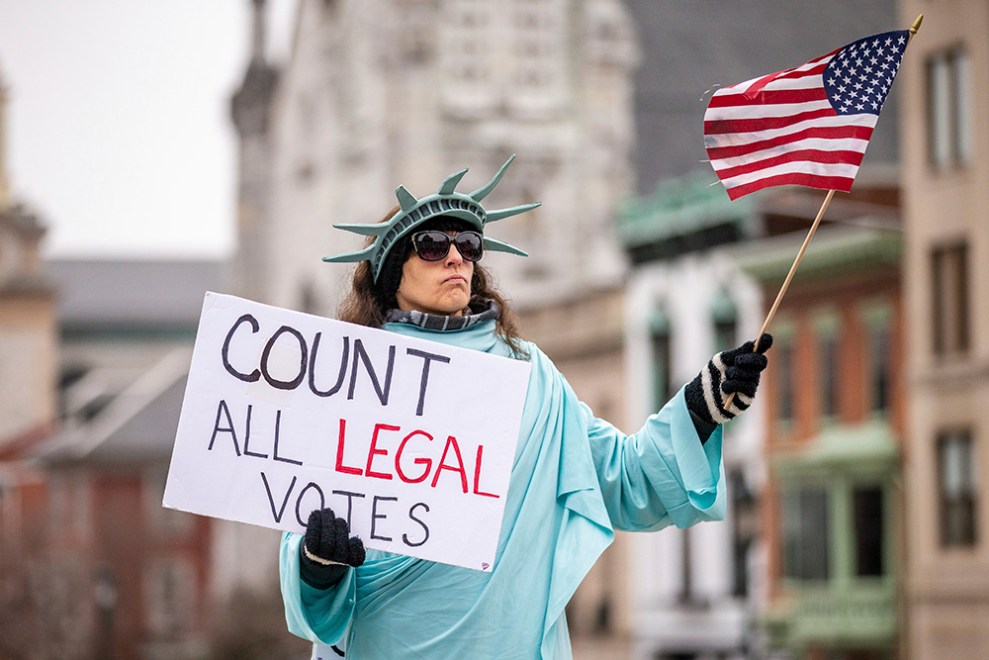
National grassroots Democratic donors have poured money into the race to help Diaz, and in the span of just a few weeks, LD-22 has emerged as an expensive battleground in a state with the highest of stakes. Republicans hold one-vote majorities in both houses of the state legislature. Democrats, facing Midterm headwinds, have little margin for error in their quest to flip the chamber. With Arizona poised to play a key role in how the 2024 presidential election is conducted, and a Civil War-era abortion ban on the books, what happens this fall could have far-reaching implications, in Arizona and beyond. Democrats’ ambitions of flipping the legislature—and keeping an election-denier out of office—hinge on whether Diaz and local Democrats are able to educate voters in time about the process. 

“This race is so critical,” Diaz says. “We don’t want it to be in the hands of the MAGA Republican.”

Continue reading

Copyright

© Mother Jones

0
  313 Hits

Paul Pelosi, Husband of House Speaker Nancy Pelosi, “Violently Assaulted” During Break-In

Paul Pelosi, the husband of House Speaker Nancy Pelosi, was “violently assaulted” during a break-in at the couple’s San Francisco home early Friday morning, according to a statement from the top Democrat’s office.

“The assailant is in custody and the motivation for the attack is under investigation,” the statement read. “Mr. Pelosi was taken to the hospital, where he is receiving excellent medical care and is expected to make a full recovery.  The Speaker was not in San Francisco at the time.”

In a press conference, law enforcement officials identified the suspect as David Depape.

The assailant reportedly used a hammer to carry out the attack. A source told the New York Times that the person was heard shouting”Where’s Nancy?” before assaulting Pelosi.

This is a breaking news post. We’ll provide updates as more information becomes available.

Copyright

© Mother Jones

0
  336 Hits

“We Don’t Need a Celebrity”: Herschel Walker Isn’t Everybody’s Hero in His Hometown

One hundred and seventeen miles Northwest of Savannah, nestled between fields of cotton and grazing livestock, sits the majority-Black town of Wrightsville, Georgia (population: 3,638).

The sleepy southern hamlet is where Curtis Dixon, now 67, taught GOP Senate nominee Herschel Walker social studies, coached him in football, and drove him to and from practice at Johnson County High School.

But from the front porch of his craftsman ranch home in Wrightsville, Dixon told me he is not supporting the candidacy of  the onetime star athlete who helped the Johnson County High School Trojans bring home the state championship football title in 1979, won the 1982 Heisman trophy as a standout running back at the University of Georgia (UGA), and played 12 seasons in the NFL.

“Herschel is a celebrity,” Dixon said. “We don’t need a celebrity, because we’re at the point where we’re about to lose our democracy.”

Walker’s performance during his October 14 debate against incumbent Democratic Sen. Raphael Warnock merely confirmed Dixon’s misgivings. In response to a comment Warnock made about a measure in the recently passed Inflation Reduction Act (IRA) that lowers insulin prices, Walker, who opposed that bill, erroneously claimed that “unless you are eating right,” insulin “does no good.”

Continue reading

Copyright

© Mother Jones

0
  340 Hits

Marjorie Taylor Greene’s District Is Bluer Than You’d Think

Deep in northwest Georgia, in what was once a patchwork of forest and farms, sits Paulding County, a quiet collection of towns that straddle two worlds. Less than an hour’s drive southeast is the sprawl and thrum of Atlanta; just to the north are the state’s mountainous rural communities, where life still moves at a slower pace. As an in-between place, Paulding doesn’t get much attention (though its meandering Silver Comet Bike Trail alone is worth the drive). But in election seasons, it occupies a unique position: Paulding is where deep blue Atlanta and unwaveringly red North Georgia meet in the middle.

Just before Georgia’s runoff Senate election back in 2020, I sat down at a Paulding County Starbucks with Andrea Baerwalde, chair of the Paulding County Democrats. Baerwalde, who was then 61 and working as a speech therapist, talked about what it was like to be an outspoken Democrat in her deep red county. Baerwalde’s yard signs were constantly getting stolen. Passersby booed and swore at Dems’ events. She had long since agreed to disagree on politics with her own family members—including her husband. Still, she told me at the time, “I think Warnock and Ossoff do have a chance.” But she added, “I always worry because I’m not used to Democrats who have a chance in Georgia. So I’m trying not to get ahead of myself.”

“I’m not used to Democrats who have a chance in Georgia. So I’m trying not to get ahead of myself.”

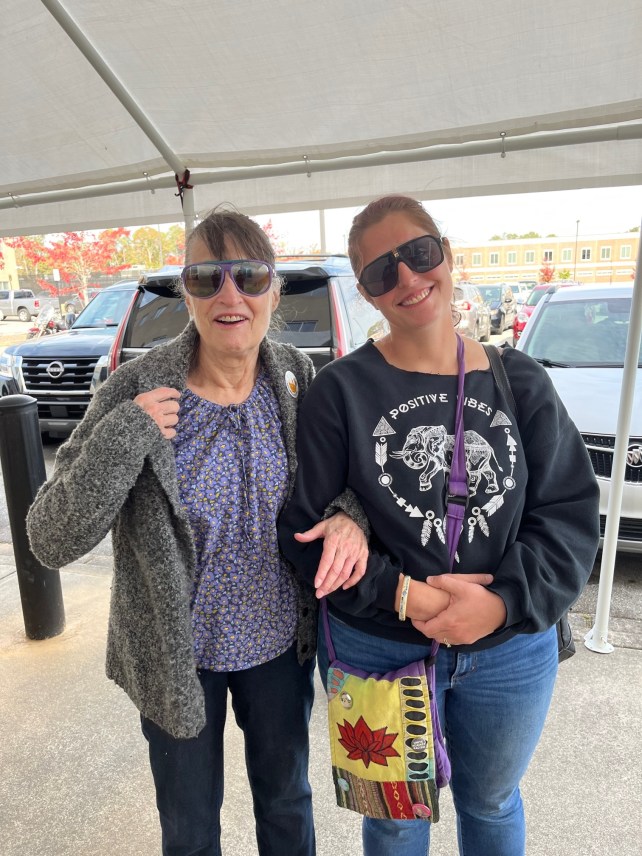
In that election her cautious optimism was warranted: Georgians elected the two Democratic candidates, thus securing a razor-thin blue Senate majority. Paulding County, however, elected conservative firebrand and conspiracy theorist Marjorie Taylor Greene as its congressional representative, and just 36 percent of its voters went for Warnock and Ossoff. And yet, compared with Hillary Clinton’s 28 percent votes in 2016, for Democrats like Baerwalde, this was an incremental improvement that she thinks will continue this election season. Yard signs are a useful barometer: This year, signs for Democrats—even those for avowed progressives like gubernatorial candidate Stacey Abrams—“stay in the same place for a little while,” she said. “Which is super exciting because usually if you see a sign, it’s gone soon.”

I was curious about the changes that Baerwalde described—and how Paulding County residents were thinking about the upcoming races. How were they feeling about Marjorie Taylor Greene two years in? Does her opponent, Army veteran Marcus Flowers, appeal as an alternative? What about all the controversies surrounding Herschel Walker—his history of domestic violence, the allegations that the pro-life candidate has paid for past girlfriends’ abortions, his own children’s disavowal of their father? Have they dimmed the enthusiasm of some Republican voters? So, earlier this week, I drove to Paulding County to talk to some residents who showed up to the polls for early voting.

It was a warm fall morning, and the highway was lined with trees just beginning to change color. As I approached the county seat of Dallas, Georgia, the old stands of the forest gave way to car dealerships, a Ruby Tuesday, and a warehouse converted into a trampoline park. Just before I reached the polling place, I stopped for a coffee at a dessert shop that shared a strip mall with a dialysis center and a bail bonds store. Next door to the strip mall was Paulding County’s Watson Government Complex, a cluster of stolid brick buildings with an expansive parking lot from which people streamed in to take advantage of early voting.

Continue reading

Copyright

© Mother Jones

0
  300 Hits

One Scientist’s Quest for an Accessible, Unhackable Voting Machine

This story was originally published by Undark and is reproduced here as part of the Climate Desk collaboration.

In late 2020, a large box arrived at Juan Gilbert’s office at the University of Florida. The computer science professor had been looking for this kind of product for months. Previous orders had yielded poor results. This time, though, he was optimistic.

Gilbert drove the package home. Inside was a transparent box, built by a French company and equipped with a 27-inch touchscreen. Almost immediately, Gilbert began modifying it. He put a printer inside and connected the device to Prime III, the voting system he has been building since the first term of the George W. Bush administration.

After 19 years of building, tinkering, and testing, he told Undark this spring, he had finally invented “the most secure voting technology ever created.”

Gilbert didn’t just want to publish a paper outlining his findings. He wanted the election security community to recognize what he’d accomplished—to acknowledge that this was, in fact, a breakthrough. In the spring of 2022, he emailed several of the most respected and vocal critics of voting technology, including Andrew Appel, a computer scientist at Princeton University. He issued a simple challenge: Hack my machine.

Continue reading

Copyright

© Mother Jones

0
  387 Hits

10 films to watch in November

10 films to watch in November

The Knives Out follow-up and a cannibal drama starring Timothée Chalamet

Copyright

© Mother Jones

0
Tags:
  255 Hits

A game-changingly bizarre Dracula movie

A game-changingly bizarre Dracula movie

How Dracula AD 1972 saw the vampire wreak havoc in swinging 1970s London

Copyright

© Mother Jones

0
Tags:
  274 Hits

Genres for War: Writers in Ukraine on Literature

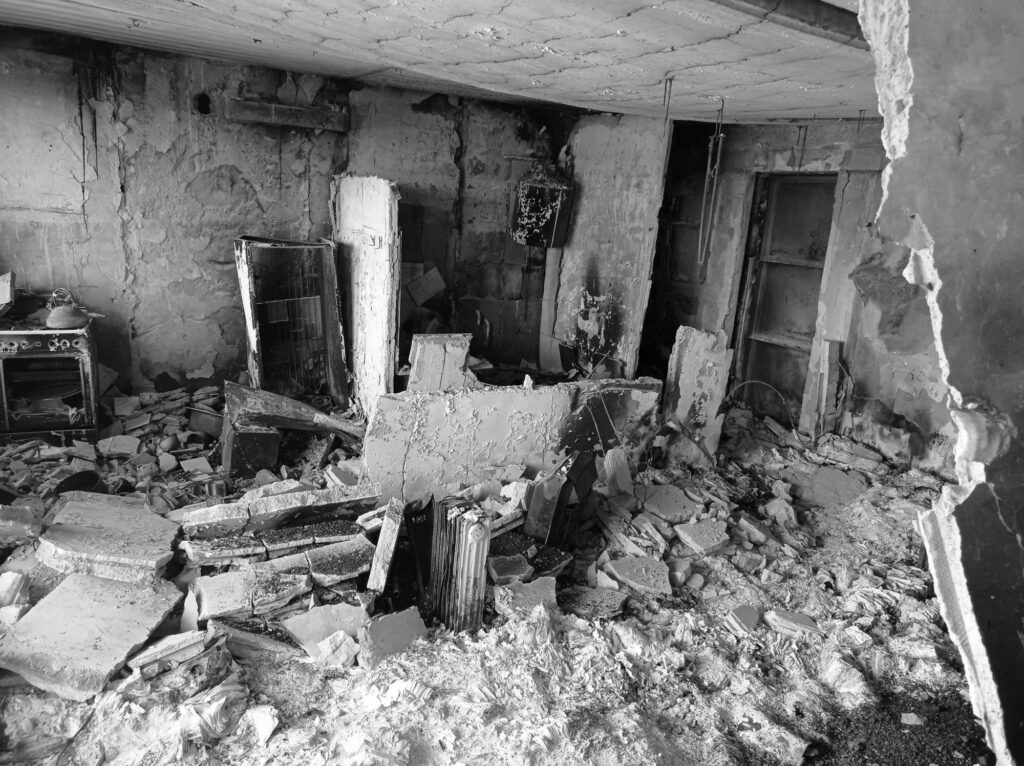
Olga Kryazhich’s destroyed apartment. Photograph courtesy of Kryazhich.

I was almost done with a draft of my novel when Russia invaded Ukraine on February 24. Amid the destruction and devastation that followed, continuing with my novel felt impossible; I turned toward journalism, which had always been a part-time job for me. For seven months, I have been working as a war correspondent in Ukraine. I have found that I can only read war reports: I am constantly turning to On the Front Line by Marie Colvin. I have wondered about the role of literature, especially in wartime: Are we simply supposed to let documentaries and daily news take over? Or do we find—and provide—an escape from the unbearable?

I began to ask other writers these questions and was surprised by the variability of their answers. Five Ukrainian writers from the Donetsk, Luhansk, and Kharkiv regions—the areas devastated by the war—spoke to me about the genres they have been reading and writing during the war. In Kharkiv, a literature professor told me about his rare books being burned in the stove by the Russian military. He also told me about a Ukrainian officer seeking reading recommendations the day before being killed at the front. “I think that an epic work of literature will not come until after the war is over,” writes Serhiy Zhadan. On the other hand, says Lyuba Yakimchuk, “The task of poets is to put the unspeakable feelings in words.” Olga Kryaziach, whose apartment and books were also burned by the Russians, reads and writes on her iPad, taking notes for a different future.

Iya Kiva

I have started to become spatially disoriented because of the war. Once, as I was getting back to a rented apartment, I couldn’t figure out where I was or how I got there for hours. I lived in a Soviet project-style block of flats called khrushchyovka surrounded by identical buildings, and I couldn’t understand which one of those khrushchyovkaswas my home these days; I was shaking and I couldn’t breathe. In another one of my rented apartments, I was always hitting my head while entering. At home, I needed to turn left after entering, but in this new space I had to turn right.

Continue reading

Copyright

© Mother Jones

0
  377 Hits