You Don’t Have to Love Afroman to Like Police Accountability

Cops failed spectacularly at using the courts to clamp down on a critic this week.

That critic was the rapper Afroman, who created music videos mocking sheriff’s deputies who raided his home in August 2022 with a warrant for drug trafficking and kidnapping. Afroman was neither charged nor arrested, and he was not compensated for damages to his family’s Ohio home. But he’s also come under fire for homophobic jokes and possibly backing Donald Trump.

If you missed the details of the case, here’s some brief background: Afroman’s home security cameras captured armed cops breaking down his door and terrifying his wife and children, who were in the house at the time. During the raid, which discovered no evidence of wrongdoing, deputies flipped off security cameras, damaged various belongings, and seized cash that Afroman said was returned short.

According to a VICE interview released in 2023, the rapper, who blew up with the 2000 comedic song “Because I Got High,” said he lost gigs due to the raid, but funneled his anger and feelings of powerlessness at the incident into making viral music videos, including “Will You Help Me Repair My Door” and “Lemon Pound Cake.” Afroman’s videos incorporate his security camera footage, with the latter making fun of one cop who glances down at a cake on the family’s kitchen counter: “They found no kidnapping victims / Just some lemon pound cake.”

Continue reading

Copyright

© Mother Jones

0
  37 Hits

Trump Wants $200 Billion for Bombs. Here’s What That Could Buy Instead.

“It takes money to kill bad guys.”

That’s how Defense Secretary Pete Hegseth justified reports that the Pentagon is requesting $200 billion in additional funding to pay for its offensive in Iran, where, as of this writing, more than $18 billion has already been spent to kill thousands, with no end in sight.

Here at Mother Jones, we started to wonder: If the Trump administration weren’t so hellbent on “death and destruction,” at a moment rife with rising inflation and recession concerns, what else could $200 billion deliver? A lot, it turns out. We broke down a few line items below.

2.8 million public school teacher salaries

Continue reading

Copyright

© Mother Jones

0
  29 Hits

Kafka’s Misdiagnosis

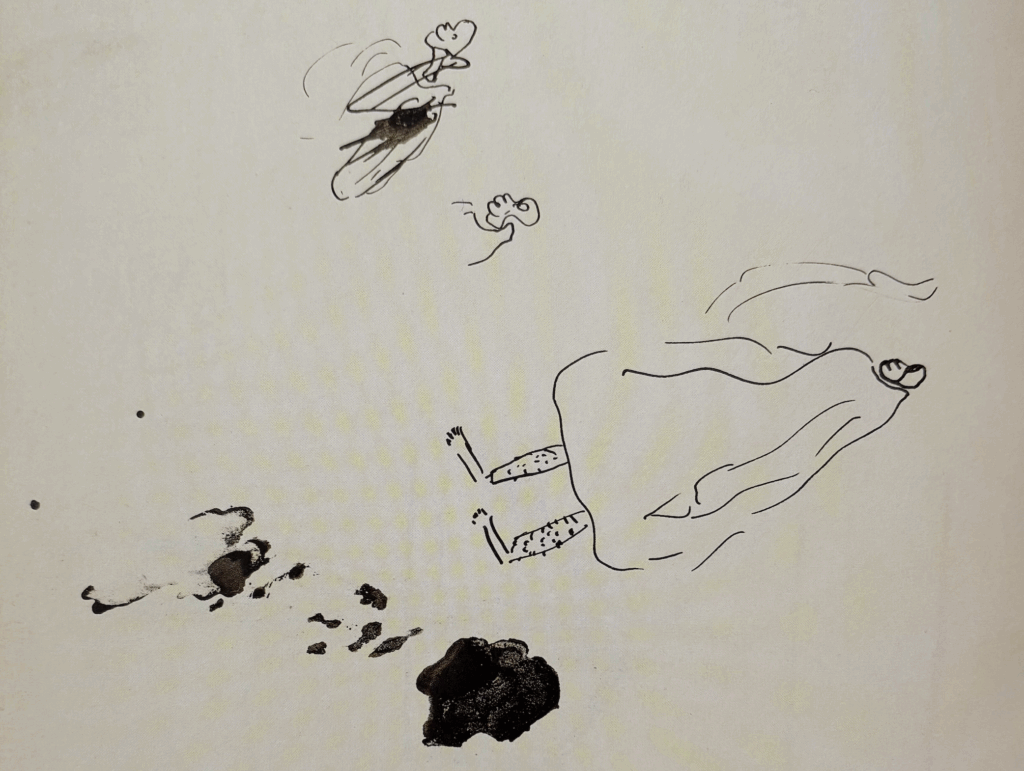
Drawings by Franz Kafka. Courtesy of the Literary Estate of Max Brod, National Library of Israel, Jerusalem. Public domain.

In a diary entry from February 1922, Franz Kafka writes of a deal he made with madness:

There is a certain failing, a lack in me, that is clear and distinct enough but difficult to describe: it is a compound of timidity, reserve, talkativeness, and half-heartedness; by this I intend to characterize something specific, a group of failings that under a certain aspect constitute one single clearly defined failing (which has nothing to do with such grave vices as mendacity, vanity, etc.). This failing keeps me from going mad, but also from making any headway. Because it keeps me from going mad, I cultivate it; out of fear of madness I sacrifice whatever headway I might make and shall certainly be the loser in the bargain, for no bargains are possible at this level.

The Kafkian protagonist (including the “I” of Kafka’s letters and diaries) is a loser who cannot make “any headway,” a schlemiel who secretly cultivates failure as the means of his persistence. The subject must lose, must fail; that’s the deal made with madness. Conversely, does this not imply that a successful Kafka would be not a socially well-adjusted, non-neurotic, even happily married Kafka, but rather a mad Kafka, one forced to pay a high price for not sacrificing headway in his pursuit, for going all the way to the end of his investigations? In “Investigations of a Dog,” the philosopher dog speaks of wanting to feed on the bone marrow of all the dogs, the marrow of truth—but then turns around and avows that this marrow is “no food; on the contrary, it is a poison.” Similarly, what if Kafka nourished himself on failure to avoid being poisoned by the truth he was seeking?

There is something profoundly unhinged about the Kafkian universe. In the first book-length study of Kafka in English (a rather eccentric work, largely forgotten today), Paul Goodman put it sharply: Relax your vigilance and “the entire order of the world will fly in pieces.” Kafka himself once called waking up “the riskiest moment”: “If you can manage to get through it without being dragged out of place, you can relax for the rest of the day.” It’s as if the interval between sleep and waking were not only a matter of fuzzy consciousness but also an ontological blurriness, threatening to open a rupture in the fabric of space-time where all sorts of demons might appear, like agents coming to arrest you for an unknown—and unknowable—crime, or a giant insect substituting for your formerly human self. Schizo- in Greek means cleft or split, and apart from the moment of awakening, there are many such figures of schizoid rupture in Kafka’s universe. “A Little Woman” opens with a delirious detail: “I have never seen a hand with the separate fingers so sharply differentiated from each other as hers; and yet her hand has no anatomical peculiarities, it is an entirely normal hand.” The too-finely-spaced fingers signal a subtle breach in the order of things, a breach into which the narrator can’t help but plunge. 

Continue reading

Copyright

© Mother Jones

0
  33 Hits

Joe Kent’s Resignation Is Tearing MAGA Apart

If you were to invent a politician ideally suited to appeal to the MAGA base, you might come up with something like this: A classically handsome white guy with a tragically sympathetic life story whose service in US special forces during senseless wars led him to embrace America First isolationism—along with a substantial dose of conspiratorial far-right thinking. That is, they might come up with Joe Kent, a former Green Beret who did 11 combat deployments and lost his wife to an ISIS suicide bomber in 2019 before entering politics as a stalwart defender of Donald Trump.

The fact that Kent’s biography is so compelling to the MAGA faithful is what makes his decision this week to resign as director of the National Counterterrorism Center in protest of the Iran war such a problem for Trump and his administration. Unlike others the president has cast aside, Kent can’t be dismissed as a lightweight or a grifter. Instead, he has been built up for years by Tucker Carlson and others on the right as a model of everything the Trump-era GOP should represent. Now by publicly quitting, Kent is fueling a broader confict that is tearing apart Trump’s coalition over the Iran war and the role that Israeli Prime Minister Benjamin Netanyahu played in pressing Trump into it.

“You wanna rip the GOP apart right to its core and prevent a single America First voter from participating in the midterms? Indict Joe Kent and Tucker Carlson.”

As Kent wrote in his Tuesday resignation letter, “Iran posed no imminent threat to our nation, and it is clear that we started this war due to pressure from Israel and its powerful American lobby.” On Wednesday evening, he made similar points in a quickly arranged interview with Carlson that has already been viewed more than 4 million times on YouTube and X. (The conversation later veered off into unsupported speculation about the assasination of Charlie Kirk and Trump’s near assasination in Butler, Pennsylvania.)

Continue reading

Copyright

© Mother Jones

0
  32 Hits

A Clarinetist, a High School Student, and Some Climate Deniers Write a Science Paper

This story was originally published by Bulletin of the Atomic Scientists  and is reproduced here as part of the Climate Desk collaboration.

It sounds like a bad joke, but last week a press release dropped into my inbox: “Leading Scientists Challenge Foundation of Climate Change Assessments, Revealing Fatal Flaws in Ocean Heat Content (OHC) Measurements.”

The article this email was promoting claims to upend the generally accepted consensus among climate scientists that greenhouse gas emissions are trapping more heat on the planet, and most of that heat is ending up in the oceans. It’s thanks to the Argo program—a fleet of nearly 4,000 robotic ocean floats that collect data on temperature and other ocean properties, like salinity—that scientists have been able to measure and track long-term ocean warming, but the paper casts doubt on those measurements.

“As promised, the climate science obliteration has arrived TODAY,” lead author Jonathan Cohler wrote on social media (his emphases). “The IPCC’s central claims have now been torn apart. The oceans are not ‘warming’ let alone ‘boiling.’ That claim is false. The claimed Earth Energy Imbalance is false. It’s no different from zero.”

Continue reading

Copyright

© Mother Jones

0
  30 Hits

The ultimate saga of British privilege and power

The ultimate saga of British privilege and power

How The Forsyte Saga encapsulated the timeless themes of class and 'new money'

Copyright

© Mother Jones

0
Tags:
  34 Hits

Mr. Rogers and the Fight for Public Media

On the anniversary of Fred Rogers’ birthday, we take a trip to Mr. Rogers’ real-life neighborhood in this special episode that celebrates the life and work of public media’s most famous defender.

Reveal’s Michael Schiller visits WQED in Pittsburgh for a look back at how Rogers, the host of Mr. Rogers’ Neighborhood, championed public television throughout its decades-long struggle to survive Washington politics.

jQuery(document).ready(function(){prx("https:\/\/play.prx.org\/e?ge=prx_149_a54f0860-1601-41dd-b8d2-39eed5552437&uf=https%3A%2F%2Ffeeds.revealradio.org%2Frevealpodcast", "prx-1", "embed")});Subscribe to Mother Jones podcasts on Apple Podcasts or your favorite podcast app.

Find Reveal on Apple Podcasts, Spotify, iHeartRadio, Pandora, or your favorite podcast app, and don’t forget to subscribe.

Copyright

© Mother Jones

0
  33 Hits

Workers in Colorado Have Shut Down One of the Nation’s Biggest Meatpacking Plants

This story was produced in partnership with the Food & Environment Reporting Network.

On Monday at 5:30 a.m., more than three thousand employees at the JBS beef packing plant in Greeley, Colorado, officially walked off the line. Members of the United Food and Commercial Workers Local 7, the union that represents the plant, had begun the first major meatpacking strike in more than four decades, effectively shutting down one of the largest meat processing sites in the country. About 7 percent of America’s beef comes out of this single plant on a normal day. But now, thousands of workers—mostly foreign-born laborers from Haiti, Somalia, Burma, and Mexico—formed a picket line across the street, singing in Haitian Creole, chanting through a megaphone in Spanish, and wearing placards that read PLEASE DO NOT PATRONIZE JBS.

They were walking out to protest stalled wage negotiations and poor working conditions. A recent class action lawsuit brought by Haitian workers at the plant claims that they have been segregated onto a night shift and forced to work at “dangerously fast speeds.” Last month’s strike vote was nearly unanimous—evidence, the union says, of worker frustration.

“I don’t think the American public has a sense that the food on our table is being produced by immigrant workers under conditions that would make Upton Sinclair turn over in his grave.”

Continue reading

Copyright

© Mother Jones

0
  30 Hits

Eight of the best podcasts of 2026 so far

Eight of the best podcasts of 2026 so far

From literary discussion show The Book Club to Get Birding with Sean Bean

Copyright

© Mother Jones

0
Tags:
  36 Hits

Making of a Poem: Joyelle McSweeney on “My Fortune”

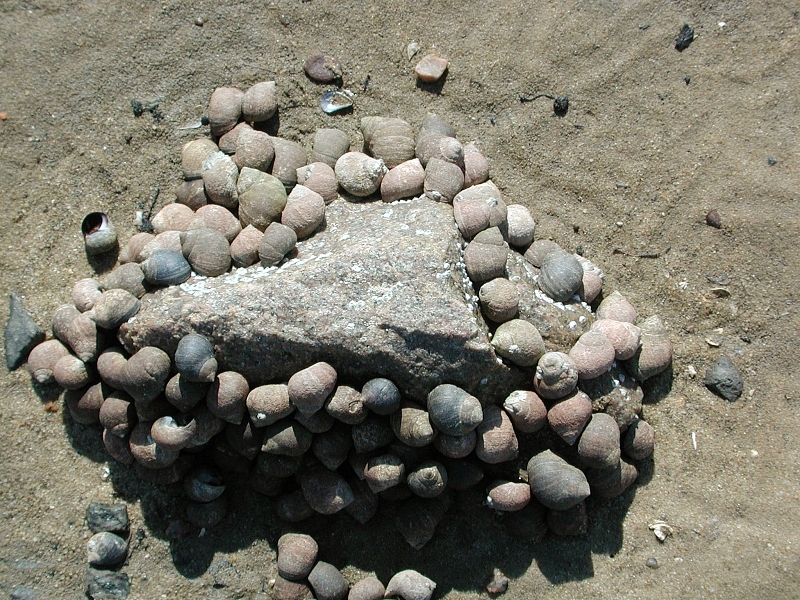
Fritz Geller-Grimm, CC BY-SA 2.5, via Wikimedia Commons

For our series Making of a Poem, we’re asking poets and translators to dissect the poems they’ve contributed to our pages. Joyelle McSweeney’s “My Fortune” appears in our new Spring issue, no. 255.


How did this poem start for you?

For about a year I found the news so bleak that I turned away from the present tense and made myself a connoisseur of Fortune—the grave goods packed into the Pharaoh’s tomb—his mask, his cats, his casket. From the window of my phone, from the cold black cell of my wakefulness, I would watch rival Egyptologists make competing cases, revolving algorithmically, in and out of view. I watched Cocktails with a Curator, a series of hypererudite videos recorded by Frick Gallery staff from their apartments in New York at the height of lockdown, replayed now in sequence like a journal of the plague year—this swain, his lover, this horse, his Polish rider, this hat, this collar, this pearl. This vial. This tipsy lethal cup.

Continue reading

Copyright

© Mother Jones

0
  32 Hits